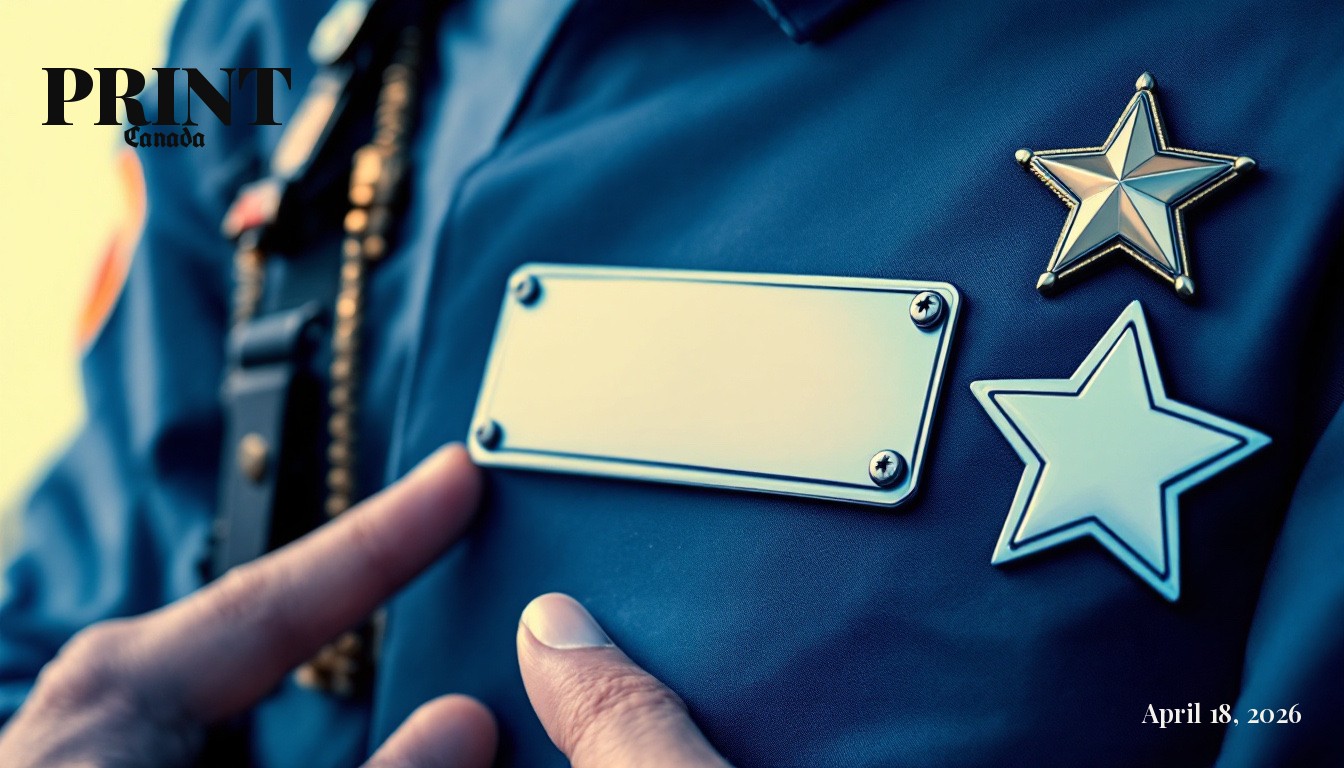
The badge number as a constitutional minimum.
An officer who refuses to give their name and number, when a citizen lawfully asks for them, has failed at the floor of their job. The country has accepted this failure for too long. There is no operational, statutory, or moral defence of it. There is, however, a long and embarrassing record of officers behaving, on the public dime, like the high-school children they once were and were never asked to outgrow.
Guelph, Ont.Every police service in this country, without exception, has a written standard requiring its officers to identify themselves, on lawful request, by name and badge number. The standards are public. They are usually published as part of the service's code of conduct. They are referenced, often verbatim, in the relevant provincial Police Services Act. They are taught at every academy. They are, in any honest reading, the floor of the office. An officer who refuses to give their name and number, when a citizen who is the subject of a lawful interaction asks for them, has failed at the floor of their job.
It is the failure that is, in this magazine's reading of an unhappy file growing thicker every quarter, the most quietly common Charter-adjacent failure in policing in this country. It is more common, on the citizen side of the encounter, than the failure to caution, the failure to facilitate counsel, the failure to administer a screening device, or the failure to produce disclosure. It is more common because it is the smallest of the floor's tiles and because, in the moment, it is the easiest to step over. It is also the most demoralising for the citizen, because it announces, with no possibility of misinterpretation, that the officer in front of them does not consider themselves accountable to anyone the citizen could reach.
The high-school problem
The phenomenon, when one talks to enough citizens who have experienced it, has a recognisable shape. The officer is asked, politely, "What is your name and badge number?" The officer responds, depending on the service and the day, with one of a small set of replies. The mildest is a deflection: "What do you need that for?" The more common is a sneer: "Ugh, like, what is that?" The least common, and the most ominous, is silence. None of these is a lawful response. All of them are, on tape and in citizen accounts now numbering in the hundreds, what officers in this country actually say.
The vocabulary of the response is what is most striking. It does not sound like a professional uncertain about a regulation. It sounds like a teenager being asked a question they did not expect. The intonation is the intonation of a person who has been given authority before they were old enough to learn what authority is for. There is a word for this kind of authority, in any sensible workplace. The word is unprofessional. There is no word for it in policing, because policing has not yet decided to use one.
What the law actually says
The law, in this province as in most others, is straightforward. Every officer in uniform on duty in this country is required, on lawful request, to identify themselves by surname, badge number, and the service they belong to. This is not a courtesy. It is, in most provinces, a regulation enforceable through a complaint process and, in egregious cases, through an internal disciplinary mechanism that can result in, at the high end, a suspension. The regulation exists because the public has, in any functioning democracy, an absolute interest in knowing the identity of the armed agent of the state who is presently exercising authority over them.
The complaint process, when invoked, is slow, opaque, and structurally unkind to complainants. This magazine has reported on its weaknesses elsewhere. The slowness of the process, however, is not an answer to the question of whether the officer has misbehaved. The officer has misbehaved. The fact that the system the officer answers to is bad at correcting that misbehaviour is a separate scandal.
The intonation is the intonation of a person who has been given authority before they were old enough to learn what authority is for.
The constitutional floor
The badge number is not a polite formality. The badge number is the citizen's only mechanism, in the moment, for asserting the parity that the Charter is meant to guarantee. The Charter does not put the citizen and the officer on equal footing in the literal sense, the officer has the gun, the cuffs, the cruiser, and the authority to detain. The Charter does, however, demand that the asymmetry be visible. The badge number is the visibility. It is what the asymmetry must wear in order to be lawful. An officer who removes the visibility has, in a small but absolute sense, disabled the Charter for the duration of the interaction. The disabling is, on its own, a serious matter. The fact that no court will, on these facts alone, do anything about it, is what makes it serious.
The fix, if there is to be one, is structural and dull. Body-worn cameras, when actually used and when actually disclosed, capture the moment of the request and the moment of the reply. Most services have the cameras. Most services do not, on the public record, audit them for this kind of failure. They could. They should. A monthly random sample of fifty interactions per service, reviewed by a civilian board, with the simple test, "When the citizen asked for the name and number, what did the officer say?", would within one quarter restore the floor that the file shows has been quietly missing for years.
The country, and what it can require
The country can require this, because the country pays for it. The country pays the salaries. The country buys the cruisers. The country writes the legislation. The country has, in the absence of any visible mechanism inside the services to fix this on its own, every right and every reason to require the fix from the outside. A police service that cannot induce its officers to give their names and badge numbers when lawfully asked is a service that has, in a small but cumulative sense, lost a piece of its own legitimacy. The legitimacy is not granted. The legitimacy is leased, every day, by the public.
It is time, in this magazine's view, to start auditing the lease.