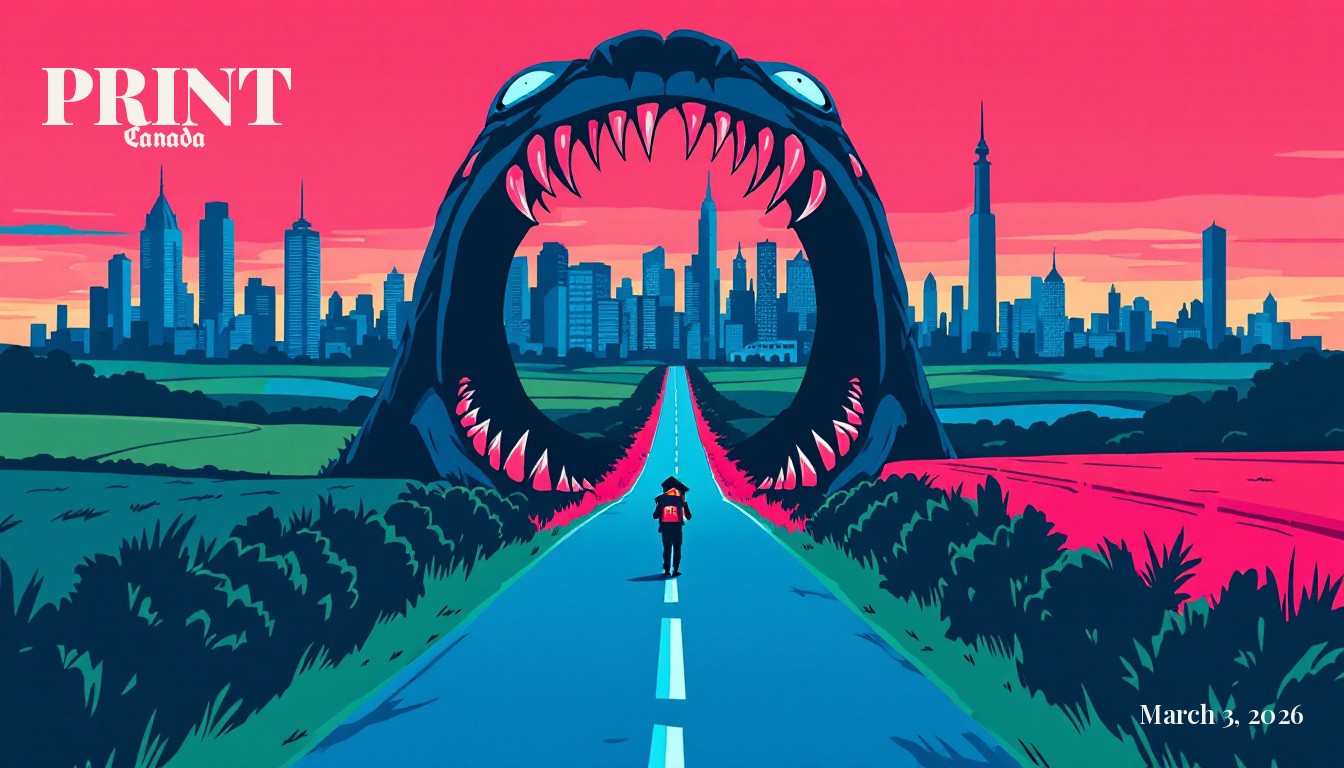
The case for the concession road.
The country's housing market is a predator. The polite advice is to bid harder. The honest advice is to leave. There is more land in this country than in almost any country on earth. Most of it has a road through it, a power line above it, and a price below the median monthly rent in any city worth fleeing.
Cape Breton, N.S.Take a long look at a parking-lot map of the country. Subtract the cities. Subtract the suburbs. Subtract the protected parks and the Crown forests and the wetland. What is left, on the math nobody runs at the kitchen table, is most of the country. The country is, by any honest description of itself, a very large piece of mostly empty land with three or four crowded edges. The crowded edges have, over the last forty years, decided to charge each other more and more for the right to crowd. The math, on the crowded edges, has stopped working. The math, off the crowded edges, has not.
This essay is not an argument that everybody should leave the city. It is an argument that, when a market becomes the kind of market the urban housing market in this country has become, the most underrated response is the door. There is a door. The door opens onto a concession road. The road has, depending on which province you are in, a number followed by a letter, and a sign, and a few houses, and a great deal of unmown grass, and a price, on a board nailed to a tree, that the urban renter would not believe if they were not standing in front of it.
The house at the end of the road
The house at the end of the road is, depending on the season, between two and seven times less expensive than the equivalent square footage in the city the renter has just decided to leave. The house has a roof, a furnace, a well, and a yard the dog will not believe. The house may need work. The work, in the country, costs less than the work in the city, because the trades who do it are paid in a currency that does not include parking, traffic, or the ambient cost of being polite to fourteen strangers per breakfast. The house, after the work, is the asset the renter was told, by every adult in their life, to acquire. They have acquired it. The acquisition cost roughly what the urban down payment would have cost. They own it. There is no mortgage above the second decimal place. The renter has become, in a verb the language scarcely uses any more, a homeowner.
The honest objections
There are honest objections. The job, in many cases, is in the city. The internet, in many concessions, is poorer than the internet in the city. The hospital, in many counties, is forty minutes away. The cultural infrastructure, in most rural municipalities, is thinner than the cultural infrastructure in the urban core. The friends, who matter more than any of these, are mostly not where the road is. These are real objections. They are not, however, a defence of paying nine hundred thousand dollars for a one-bedroom condominium with a balcony onto a freeway.
What the country has produced, in the urban housing market, is a mathematical absurdity that has been allowed to feel like a moral norm. The norm is: bid harder. The norm is: rent longer. The norm is: postpone the family. The norm is: accept that ownership is for the people who already had it. The norm has been so loudly announced, by every interested party, that the alternative has become almost invisible to the audience the alternative would best serve. The alternative is: go.
There is a door. The door opens onto a concession road. The price, on a board nailed to a tree, the urban renter would not believe if they were not standing in front of it.
What rural Canada is, and is not
Rural Canada is not, in the year two thousand and twenty-six, the rural Canada of the country's grandparents. It is wired. It has a grocery store within a thirty-minute drive of most concessions. It has, on most lines, a cell signal. It has, in most counties, a small hospital with a fully credentialed family practice that is, awkwardly for the urban file, accepting patients. It has, in many municipalities, fibre internet faster than the internet in some of the new condominiums in the city. It is not the wilderness. It is the part of the country that the country forgot it owned.
It is also, and this is the part that matters most, the part of the country in which the math of an ordinary middle-class life still works. A family of four, on two modest salaries, can buy a house, raise the children, drive a car that does not bankrupt them, save for retirement, and have a yard. None of those nouns describes the urban file in 2026. All of them describe the rural one, plainly, without exception, in dozens of counties this magazine has, this year, visited.
The polite advice, and the honest one
The polite advice is to bid harder. The polite advice is what every actor in the urban housing market wants you to take, because the urban housing market is, by structural design, a system that benefits when more people bid. The polite advice is what your bank wants you to take. The polite advice is what your real estate agent wants you to take. The polite advice is what, in some quiet rooms, your government wants you to take, because the urban housing market is the country's largest tax base and the country's most fragile asset class, and the government does not, in any honest reading of its incentives, want you to leave.
The honest advice is the door. The door opens. The road is there. The house is there. The math, off the road, still works. This magazine, which is published in print and posted from a small post office in a small town, will continue, every issue, to remind its readers of this fact. The country is not full. The country is full of rooms it has stopped renting to itself.