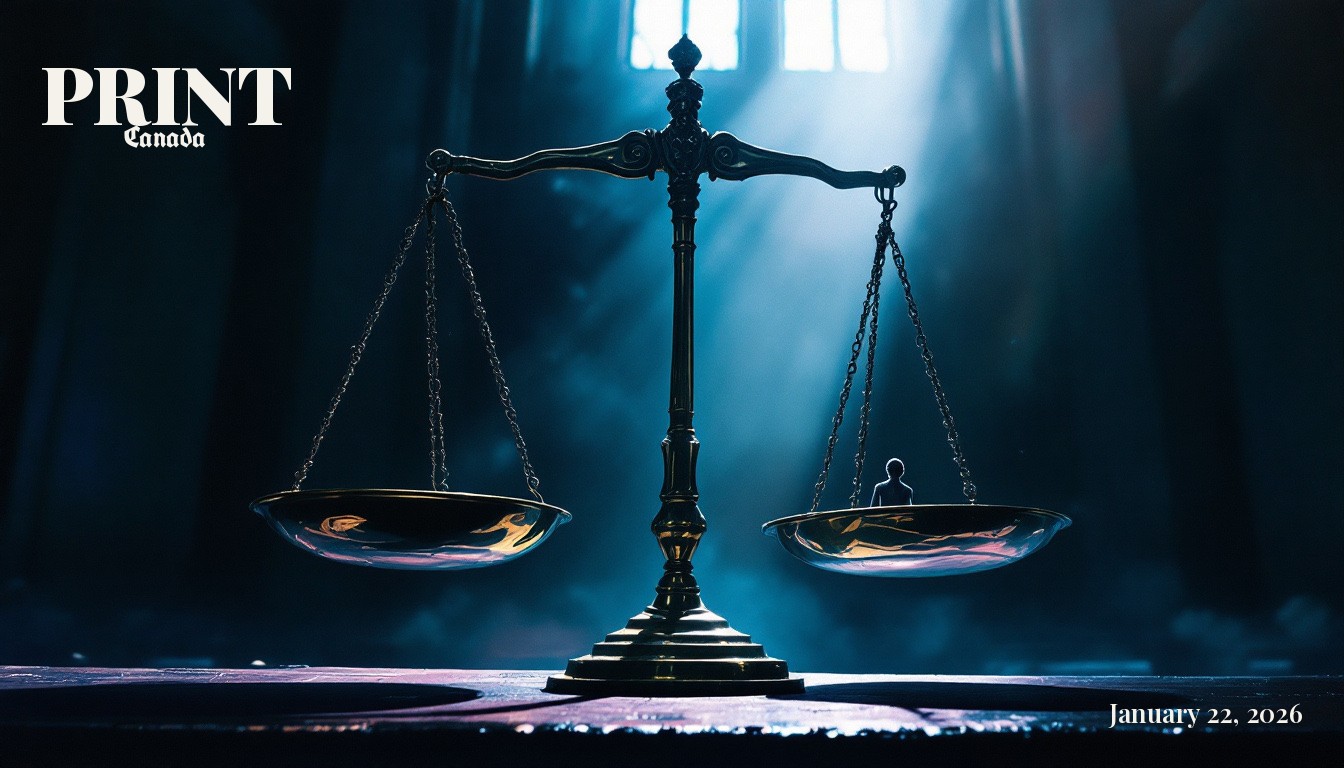
The fair trial we no longer offer.
Section 11(d) promises the accused a fair hearing before an independent and impartial tribunal. The promise is being kept, in the country's criminal docket, less and less often, and almost never for the addicted. The country built jails when it should have built care. The bill, when the country eventually pays it, will be larger than the savings the country thinks it has made.
Kingston, Ont.Section 11(d) of the Canadian Charter of Rights and Freedoms is one of the shortest sentences in the country's most important document. Any person charged with an offence has the right, the section says, to be presumed innocent until proven guilty according to law in a fair and public hearing by an independent and impartial tribunal. Eight gerunds, two participles, one noun the country has come to honour mostly in the breach. The noun is fair. The promise is what fair, in any honest reading of the file, requires.
What fair requires is that the accused, before the verdict, is presumed not to have done the thing. What fair requires is that the accused has counsel, has time, has the disclosure, has a courtroom in which the matter is decided on the evidence rather than on the calendar. What fair requires is that the tribunal, which is to say the judge, is independent, which is to say not subject to inappropriate pressure from the Crown, the police, the politicians, or the press. None of these requirements is exotic. All of them are increasingly aspirational.
Where the promise is breaking
The promise is breaking, in this country's criminal docket, in three places. The first is delay. The Supreme Court, in R. v. Jordan, set a constitutional ceiling. Provincial court matters must, presumptively, conclude within eighteen months of charge. Superior court matters within thirty. The presumption is being defeated, in the most populous provinces, with a regularity that would have struck the Court that drafted Jordan as a national emergency. It is not described as a national emergency. It is described as a queue.
The second is disclosure. R. v. Stinchcombe requires the Crown to produce, to the accused, all relevant material in its possession. The relevant material, in modern files, includes body-worn camera footage, dashcam footage, in-cruiser audio, dispatch logs, internal correspondence, and the policy documents that govern how the investigation was supposed to proceed. The disclosure obligation is well known to every prosecutor in this country. It is honoured, in many files, only after the kind of demand that requires the accused to know to make it. Self-represented accused, who are an increasing share of the docket, often do not know to make it. The disclosure does not arrive. The trial proceeds without it. The trial is not, on any honest reading of section 11(d), fair.
The third is the population the system processes. A meaningful and growing share of the people facing charges in the country's criminal courts are people whose presence in the courtroom is the consequence of an addiction the country has failed to treat. The charges, in many of these files, are property charges, breach charges, and possession charges that do not, on the merits, require a courtroom at all. They require a clinic. The country has not built the clinic. The country has built, instead, more docket. The docket fills.
The addicted
It is the addicted, in this magazine's view, where the promise of section 11(d) is most disgracefully broken. An accused person in active untreated addiction cannot, by any honest description of the cognitive demands of a trial, fully participate in their own defence. The accused, depending on the substance and the duration, may be unable to attend the appearance. May be unable to follow the disclosure. May be unable to keep counsel. May be unable to give the kind of considered instruction that the courtroom requires the lawyer to receive. The trial, when it happens, is not the trial Section 11(d) describes. The trial is a procedural completion. The accused, at the end of the procedure, goes back into the same condition the procedure pretended to rule on.
The country, in its quieter and more honest moments, knows this. The country has tried, in fits, to address it. Drug courts exist in some jurisdictions. Diversion programs exist in others. The Mental Health Act, in most provinces, provides a tool for involuntary care in the narrow set of circumstances in which a person is a danger to themselves. None of these is, at the scale of the actual problem, sufficient. The actual problem is that the country is using its criminal courts as the default disposition for a population whose primary file is medical. This is not a judgment about the criminality of any particular act. It is a judgment about the appropriateness of the venue.
The country built jails when it should have built care. The bill, when the country eventually pays it, will be larger than the savings the country thinks it has made.
Care, not custody
The unfashionable proposal, in this room, is that addiction belongs in the health system. This is unfashionable because it costs money the criminal system has, by inertia, already been allocated. Reallocation is harder than allocation. The reallocation, however, is the file. The file, on every honest cost-benefit accounting that has been done in this country and elsewhere, comes back the same way. A bed in residential treatment costs less per day than a bed in a remand centre. A wraparound program with case management costs less per year than a year of recurrent court appearances and short custodial sentences and post-release relapse and re-arrest. The country, when it has chosen the criminal route, has chosen the more expensive option. The country has done so because the more expensive option is the one that requires less explanation to the voters.
What a country could ask itself
A country could ask itself, in the next budget cycle, whether the tens of thousands of court appearances per year that involve an accused whose primary file is addiction are an appropriate use of the courtroom. A country could ask itself whether a Crown discretion to divert these matters to medical care, before the docket is reached, would, on five-year economics, save money. A country could ask itself whether the section it wrote in 1982, in the document the country still calls its most important, is in fact being honoured by the system the section was written to constrain.
This magazine's answer to all three questions is the same. The court is not the right venue. The criminal record is not the right consequence. The promise of section 11(d), for the addicted, is not being kept. The promise was the country's. The country, on the record this magazine has read, has been quietly breaking it for at least a decade. The breakage is recoverable, but only if the country first agrees to look at the file. The file is on the desk. The desk is in the courtroom. The courtroom is full. The accused is, on the morning of the appearance, not always able to attend, and when they cannot attend, the warrant issues, and the cycle begins again.
Stop the cycle. Build the clinic. Pay for the bed. Honour the promise. The country can afford the truth. The country cannot, much longer, afford the lie.