Forty thousand promised, and the years it took to keep it.
Canada flew thousands out of Kabul in August 2021, then promised to resettle forty thousand vulnerable Afghans. It met the number, and exceeded it. But the people the program was built for, the interpreters who worked beside Canadian soldiers, spent the most dangerous months of their lives waiting. A retrospective on a promise kept slowly.
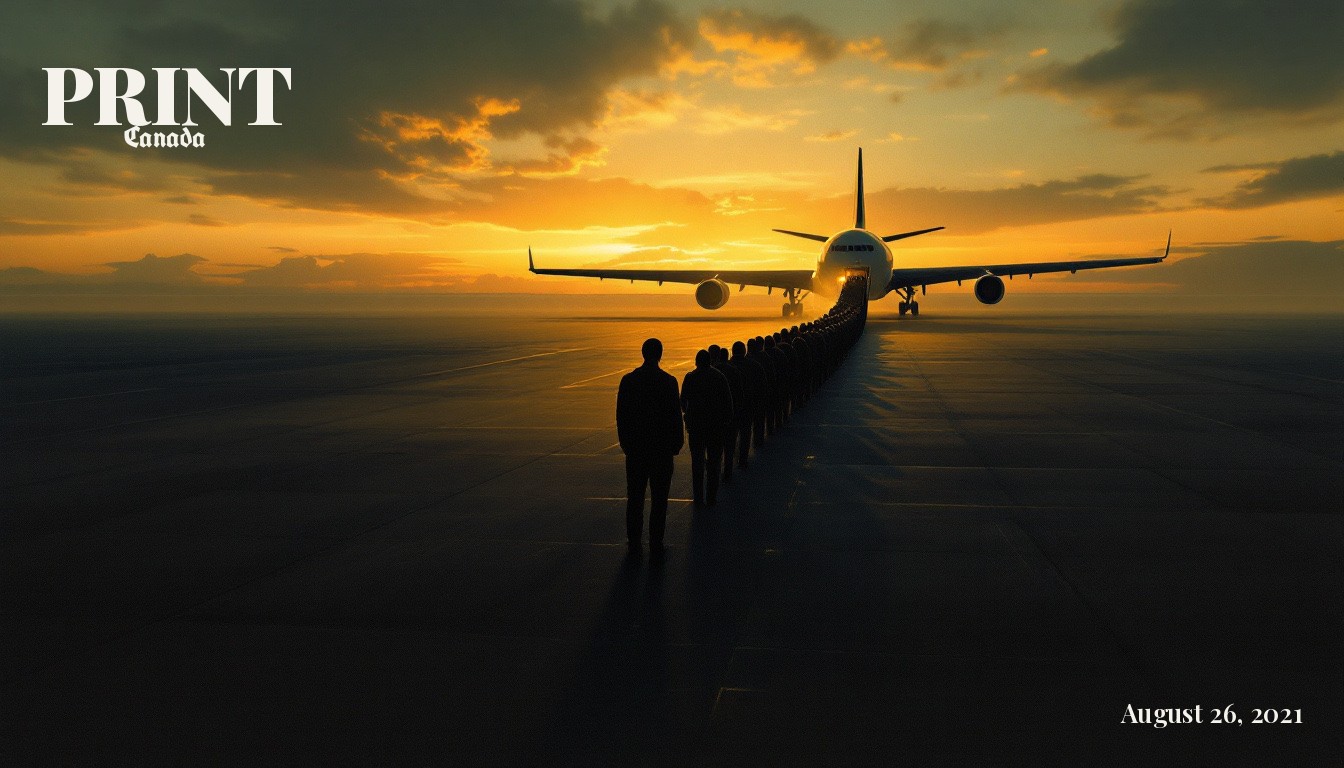
KabulOn the twenty-sixth of August, 2021, the last Canadian flight lifted off from the airport at Kabul, and the part of the rescue that the world could see was over. Between the fourth and the twenty-sixth of that month, under the operation Canada called AEGIS, roughly three thousand seven hundred people had been flown out, most of them on Canadian Armed Forces aircraft, through crowds and checkpoints and a suicide bombing at the gates. It was, by the measure of those three weeks, a genuine feat. It was also, by the measure of everyone left standing on the wrong side of the wire, a beginning that looked from the ground like an ending.
What the airlift could not do was reach everyone it was meant to reach. Officials briefing reporters at the time said they were holding applications representing some eight thousand people, that about two-thirds had been processed, and that they could not say how many of the rest had made it out. Canada had been trying to bring some six thousand support staff and their families to safety before the American withdrawal closed the airport on the thirty-first. The arithmetic of those numbers is the whole story. The people the country most wanted to save were, in large part, the people it could not reach in time.
The number, and the promise behind it
In the weeks after Kabul fell, Canada made a commitment with a clean, quotable figure attached: it would resettle at least forty thousand vulnerable Afghans. The minister responsible predicted it would take about two years. That prediction turned out to be accurate, which is its own kind of admission. The target was announced as met in October 2023, roughly two years after the promise. By early November 2024, the count had passed fifty-four thousand. On the raw numbers, Canada did the thing it said it would do, and then some. On a per-capita basis its commitment was among the largest in the world, second in absolute terms only to the United States.
A target met is not the same as a person reached in time. Canada kept its number. The men who had stood next to Canadian soldiers spent two years finding out whether the number would arrive before the Taliban did.
Who the streams were built for
The forty thousand were not one group. The largest stream, around eighteen thousand people, was for those with what the government called a direct, significant and enduring relationship with Canada through their work for National Defence or Global Affairs: the interpreters, drivers, cooks and fixers who had made the Canadian mission possible. A separate allocation of five thousand was set aside for extended family of interpreters already in Canada, people who had been left off earlier resettlements. And a humanitarian stream took in Afghans at particular risk, women leaders, members of the LGBTQ community, human rights defenders, journalists, and religious and ethnic minorities. Each category describes a real category of danger. Each also describes people who, for the two years the program took to fill, were living somewhere the Taliban could find them.
What is fair to say, on both sides
It would be dishonest to call this a broken promise. The promise was kept, and exceeded, and Canada's effort stands up well against almost any comparable country. It would be equally dishonest to leave it there. The honest fact is that the speed of August 2021, the special-forces escorts, the round-the-clock flights, was never matched by the speed of the resettlement that followed. People who had carried a Canadian rifle's worth of risk by association spent the most dangerous stretch of their lives filling out forms and waiting for an answer. The country that treats arrivals as a number to be hit, the same instinct we traced in our piece on the students the country courted, then blamed, can hit the number and still leave the person waiting too long. And the pattern of tying a worker's safety to paperwork and a single sponsor is not unfamiliar, as our piece on the permit that ties a worker to one boss set out.
The verdict
Forty thousand is a real number, kept and surpassed, and the people who reached safety are not abstractions to be argued over. But a rescue is judged at both ends, by who gets out and by how long the rest are made to wait. Canada was fast when the cameras were at the airport and slow in the years after, and the gap between those two speeds was measured in the lives of the people who had trusted it most. The promise was good. The keeping of it was honest in the end and far too slow in the middle, and both of those things belong in the same sentence.
A retrospective published in 2026. This essay draws on the public record: Canada's August 2021 Kabul airlift, conducted as Operation AEGIS, which evacuated approximately 3,700 people between August 4 and 26, 2021; contemporaneous official briefings on the number of applications held and people unable to be evacuated before the August 31 deadline; Canada's commitment to resettle at least 40,000 vulnerable Afghans; the October 2023 announcement that the target had been met; and figures published by Immigration, Refugees and Citizenship Canada indicating more than 54,000 Afghans resettled as of early November 2024, across defence and global-affairs, extended-family, and humanitarian streams. Written with deliberate factual care.