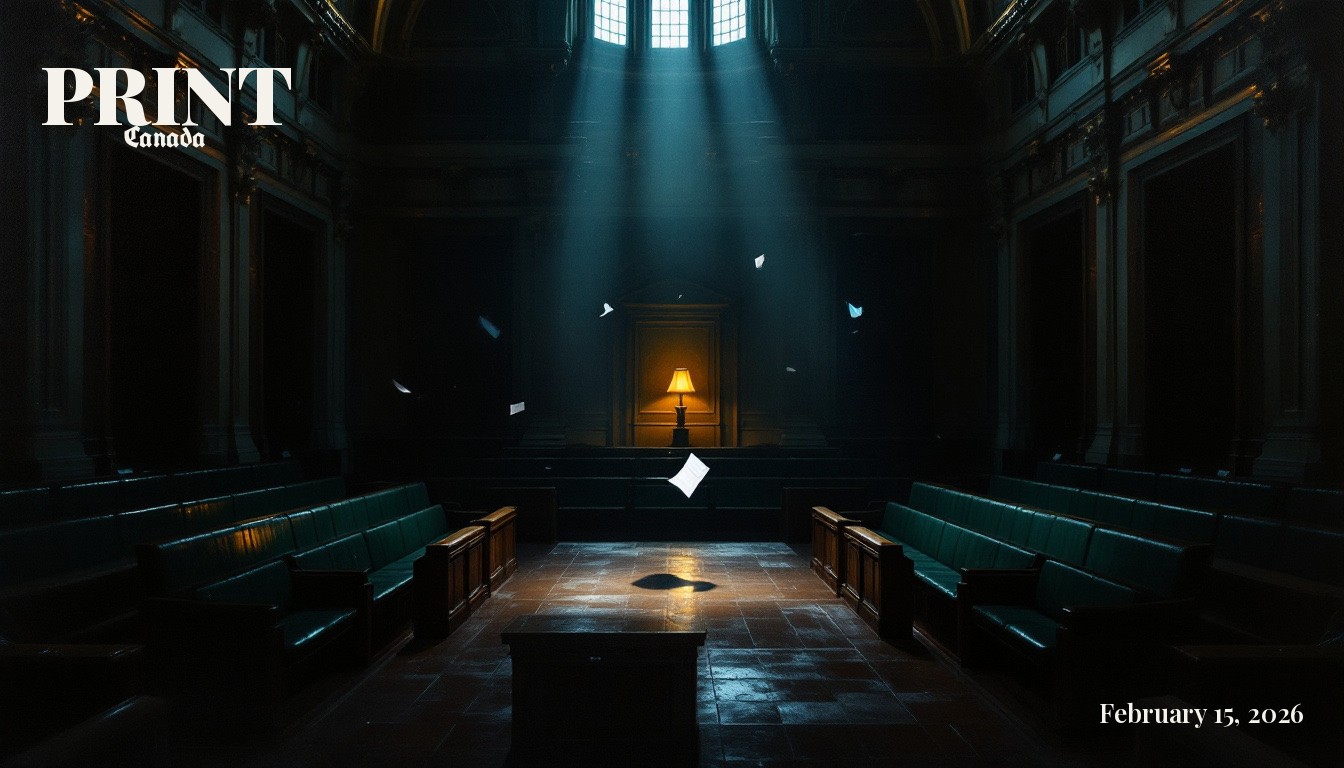
The long quiet after the vote.
A minority Parliament. A country half-listening. What it means when the loudest voice in a democracy is the silence after a result.
OttawaWalk through any federal riding the week after an election and you will hear the same noise, which is no noise. The lawn signs are stacked behind a campaign office that already has the lights off. Volunteers have gone back to whatever they were doing before they cared too much about a riding map. The press has shifted from the war room to the explainer. Cabinet is being built somewhere on a whiteboard you will never see.
This is the long quiet. Every Canadian election ends in it. It is not, despite appearances, a rest. It is the part of democracy where the actual decisions get made.
What the polls do not show
Polling tells you what the country thinks at the moment of asking. It does not tell you what the country thinks the day after a result lands. The day after a result, an entire population recalibrates. People who voted for the winner relax, then forget, then look up six months later and ask why nothing has happened. People who voted for the loser harden, then disengage, then become the rump audience for whichever new outlet starts shouting loudest. Both groups stop reading the bills.
This is the deepest fact about a parliamentary democracy in 2026, and the one least commented on. Almost no one reads the bills. Not the voters, who are tired. Not the press, which is starved. Not the opposition staffers, who are triaging amendments. Not even the bill's own ministers, who outsource the reading to chiefs of staff who are themselves outsourcing it to deputies. The bill becomes, by the time it is law, a long agreement between rooms.
Minority math
A minority Parliament makes the rooms smaller. The cabinet has to count to a confidence threshold every Wednesday. The smaller party at the table extracts concessions early and visibly, then larger ones quietly. The opposition, sensing a writ that could drop in any season, hoards positioning rather than spending it. Committees become slower. Question Period becomes louder. The actual delta of policy in any given month becomes smaller.
This is fine, in a particular reading. Minorities slow down bad ideas. They also slow down good ones, which is where the country is actually paying. The procurement file slows. The criminal justice file slows. The immigration levels file slows. The infrastructure file slows. The country, as a result, gets a Parliament that prefers no answer to the wrong answer, which is not the same as governing.
The long quiet is not a rest. It is the part of democracy where the actual decisions get made.
What a riding looks like in November
Drive through Brampton at six on a weeknight in November. The signs are gone. The MP's office has new posters about constituency week. Most residents could not name the new MP if you stopped them at a Tim Hortons. They could, however, tell you that rent is up, that the family doctor list is closed, that someone in their building was assaulted last month, and that the bus is late. None of those facts will move in the next twelve months unless cabinet decides they will. Cabinet has not decided.
This is the gap that matters. Not the gap between parties. The gap between what the country knows about its own life and what the political class is currently working on. The political class is working on procurement, on confidence agreements, on supply side fixes, on quiet legal reform, on ministerial mandates with bullet points that read like a corporate retreat. The country is working on rent.
The quiet itself, as politics
You can govern out of the quiet. Most premiers do. Most prime ministers prefer it. The press cycle on any given file lasts four days. After four days, the file goes back to its officials. The officials get an extra month. In a minority Parliament, they get an extra year, because no one is going to risk a confidence vote on a procurement reform that no one outside Ottawa cares about.
The job of a magazine, in this country, is to use the quiet. The quiet is when you read the actual bill. The quiet is when you find the official willing to talk on background about why the file moved sideways. The quiet is when you check whether the consultation produced a single sentence the consulted recognise. The quiet is when journalism that calls itself news becomes journalism that is actually news.
PRINT begins in the quiet. We are not interested in the noise. The noise is well covered. The country is not, in our view, suffering from a shortage of takes. It is suffering from a shortage of patience. We will try, through these pages, to put some patience back on the table, between the condiments.
The long quiet after the vote is the country's most honest moment. The lawn signs are gone. The cabinet is being built. The bills are sitting on desks. Read the bills.