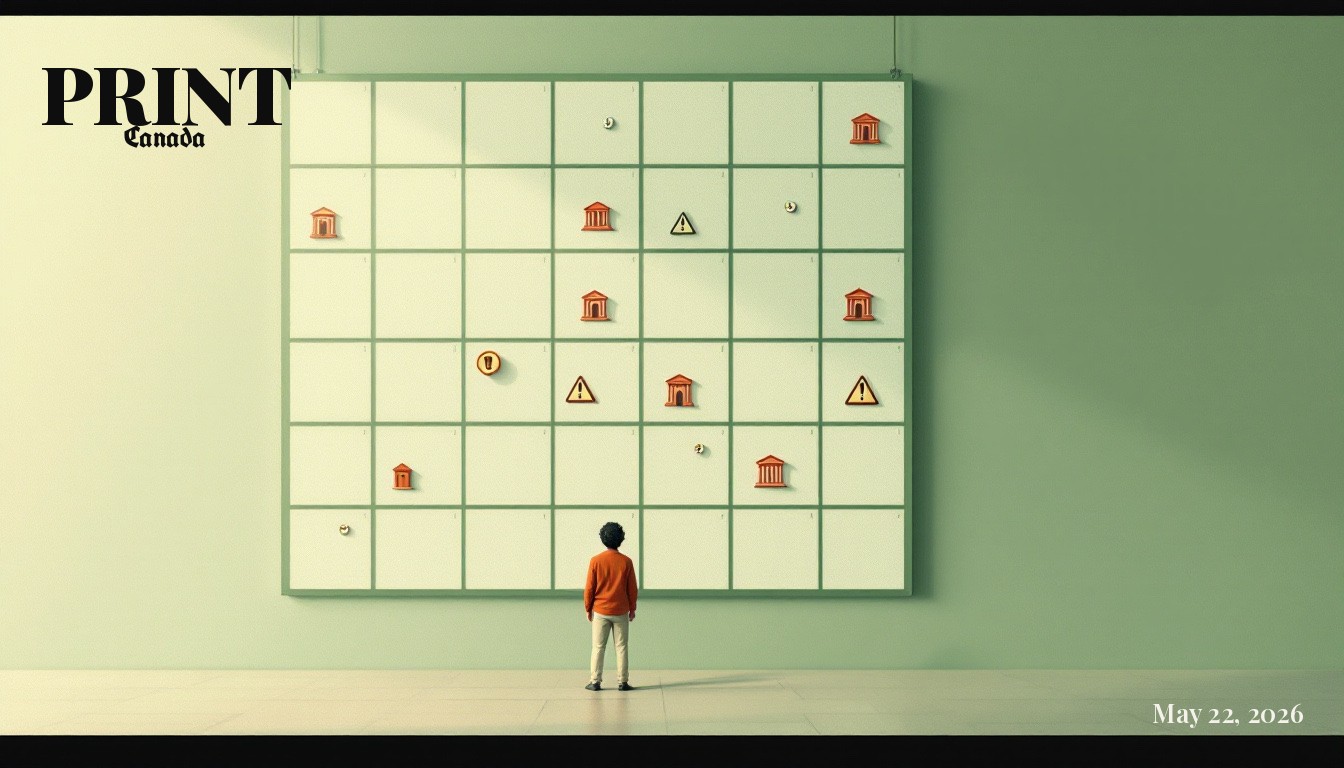
Six dates, one citizen, one Ontario late spring.
A wall calendar in a small Ontario household, photographed this week, contains six entries between now and the end of June. Two criminal appearances. Three civil hearings. One regulatory deadline. The entries belong to a single citizen. The citizen did not seek any of them. The country, through its institutions, sent each one. This is what a working Ontario calendar now looks like, when the institutions are the ones writing the entries.
Kingston, Ont.In the kitchen of a small Ontario household, beside the kettle, on a wall the calendar shares with a printed photograph of a relative's wedding, sits a paper monthly planner that the citizen has been keeping for the better part of two decades. The planner is the country's last common technology of organisation. The planner is, on the kitchen of this household this week, full. There are six entries on the calendar between now and the last day of June. Each one is the consequence of an institution the citizen, until twelve months ago, had had no reason to think about more than once a decade. Today, each one of them has a designated square. The citizen, when he reads the squares in order, reads them as a kind of liturgy. The country, on the same squares, reads a docket.
This article will not, for reasons of restraint, identify the citizen or any of the institutions. It will, however, walk the calendar. The walk takes about six minutes. The walk is, in this magazine's reading, the most honest description of what citizenship in this country has become for a meaningful and growing share of its working-age population.
The first entry, early next week
The first entry on the calendar is the response deadline on a formal demand letter sent by a paralegal acting on the citizen's behalf to a private institution in the consumer-services sector. The demand letter sets a thirty-day window. The window expires the morning the entry on the calendar marks. The citizen, when the window closes, will, depending on the institution's response, either close the file or open the Form 7A. The institution has, at the time of going to press, not responded. The Form 7A is drafted.
The second entry, early June
The second entry is a Small Claims Court Settlement Conference, by Zoom, in a matter that has been on the citizen's file since January. The defendant is a national insurance company. The conference is the procedural step at which the bench is asked whether the file can be resolved without trial. The defendant's counsel will, on the modal practice in this kind of file, attend. The defendant's counsel will, on the modal practice, make an offer that is materially less than the citizen's loss. The citizen will, on his own documentary record, decline. The matter will be set down for trial. The trial date will be, on the present provincial docket, somewhere between eight and fourteen months further out.
The third entry, mid-June
The third entry is a regulatory compliance deadline. The citizen has, in support of a separate file, made a written request to a federal regulator for the production of records the regulator is obliged to produce in a defined timeframe under the relevant federal statute. The deadline is the date by which the regulator must respond. The regulator, on the citizen's contact records to date, has been polite, slow, and uncertain whether the request falls within its jurisdiction. The deadline is the moment at which the regulator's politeness will be tested against the statute. The statute, on its face, supports the citizen.
The fourth entry, mid-June, Zoom
The fourth entry is a Small Claims Court Assessment Hearing, by Zoom, in a matter against a national vehicle manufacturer. The hearing is the bench's opportunity to assess damages on the documentary record now in the court's possession. The citizen will appear, self-represented. The defendant will appear, on the modal practice, through external counsel. The bench will be asked, on the disclosure record, to make a finding the citizen has spent fourteen months working toward. The finding, when issued, will be in the range of forty to fifty thousand dollars. The defendant's counsel will, in due course, advise the defendant whether to comply with the order or to appeal. The citizen will, in the meantime, return to his kitchen and cross the entry off the calendar.
The fifth entry, late June, in person
The fifth entry is a criminal appearance at an Ontario Court of Justice in this region. The matter is the citizen's. The appearance is a procedural step. Eight motions are prepared. The defence has, in writing, requested a date for a Charter application that is, on the published case law, the strongest single argument in the file. The Crown has, in writing, declined to consent to the date. The bench will be asked to set it. The bench may or may not. The citizen will return home that afternoon, and the matter will be added to the second-half calendar, which, on the citizen's working ledger, runs from July through November.
The sixth entry, the last day of June
The sixth entry is a second criminal appearance at a second Ontario Court of Justice in a different but adjacent region. The matter has been on the citizen's file since the winter. Eight Charter breaches are alleged. The Crown has, on the documentary record, been served with a Notice of Constitutional Application invoking sections 7, 8, 9, and 10(b). The bench has been served with the same notice. The Crown has not, in the months since service, indicated whether it intends to oppose or to concede any of the specific breaches. The citizen will appear, self-represented. The citizen has a binder, the binder has tabs, and the tabs have been arranged, on the citizen's spouse's quiet correction the previous evening, in the order the case law would prefer them to be read.
The country, on the same squares, reads a docket.
The calendar, in total
Six entries. Two criminal. Three civil. One regulatory. Five of the six in front of a bench. One in front of an inbox. All six on the calendar of a single household, in a single province, in the late spring of a single year. The household contains, in addition to the citizen, two other adults and four pets, none of whom asked for any of these dates. The household's grocery list, on the same calendar, has been postponed three times because the cumulative time cost of the docket has, on the citizen's working hours, exceeded what would otherwise be spent on the household's domestic logistics.
This is the operating reality the country has, without any single moment of decision, created for a meaningful and growing share of its citizens. The citizens involved are not, on any honest description, criminals. They are not, on any honest description, frivolous litigants. They are citizens who, at six different moments in the past eighteen months, decided not to accept an answer that an institution gave them, and who, by that decision, were enrolled into a system the country has spent forty years allowing to slow down.
What the calendar says about the country
The country, when it reads its own statistics, reads the calendar as evidence of an engaged citizenry. The country's justice ministers, on the rare occasions on which they comment on the small-claims docket, describe an accessible system, a friendly form, a low filing fee, a docket that, despite delays, eventually produces a result. None of this is, on a careful read of the calendar above, false. None of it is true either, in the way that the country thinks it is true. The calendar above is, in the citizen's life, an unbroken series of weeks taken away from the things citizens are supposed to spend their weeks on. The calendar is the country's recurring tax on the citizens who pushed back. The country does not, in any current statistic the country publishes, measure the tax.
The citizen will pay it. The citizen has decided to pay it. The decision was, in the months since the first entry was added to the calendar, the citizen's last available form of political expression that did not require him to belong to a party. The country, when it next renews its mandate at the polls, will not see the calendar. The calendar will, however, see the country.
The verdict
Six entries. One citizen. One late spring. The country can keep filling the squares. The citizen has, on the morning this article goes to press, taped a fresh blank page to the wall for the months ahead. The blank page is the country's responsibility now. The country has not, in any signal the citizen has read in the last twelve months, indicated that it intends to do less of the writing.
Stop filling the squares. Or pay the citizens for the writing.