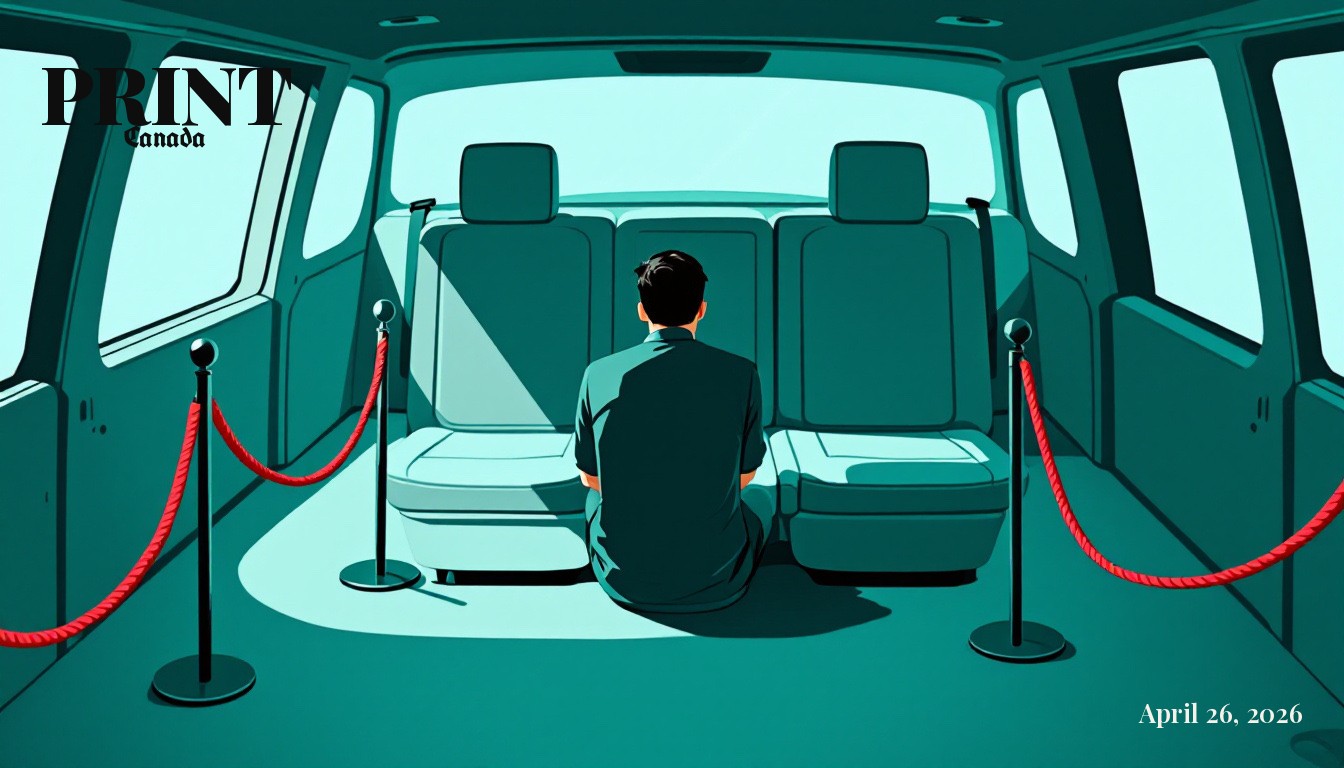
The back seat, and other things the country calls bail conditions.
An Ontario bail order requires the accused to ride only in the back seat of any vehicle in which the accused is a passenger. The accused, before the order, had insisted on his right to speak with the lawyer of his choice and had declined to sign a Form 11 in the absence of that consultation. The country imposed the back-seat condition anyway. The country also called it justice.
Guelph, Ont.In a current Ontario bail file before this magazine, the accused has been released on a recognizance that includes, among other conditions, a requirement that the accused, when present in any motor vehicle as a passenger, sit only in the rear seat. The condition is not framed as a recommendation. It is, on the order itself, a binding term of release. A breach is, under section 145 of the Criminal Code, a separate offence carrying its own sentence. The condition was imposed at a hearing the accused attended without counsel. The accused had insisted, at every prior stage of the matter, on his right to consult the lawyer of his choice. The right had not been honoured. The accused had, in the absence of that consultation, declined to sign the document the police had presented for signature. The bail-condition page now in the file is the document that resulted.
The condition has no operational meaning. The accused is not on the order on the basis of any alleged offence involving the front seat of a motor vehicle. The accused's conduct, in the moments preceding arrest, is not in dispute as a matter to which the front-versus-back distinction is relevant. The condition was selected, on the apparent reasoning available in the form's check-box layout, because it was a condition the officer could check. No part of the file in front of the bench at the hearing, on the bench's own subsequent comments, contained a reasoned justification for it. The condition is, in any meaningful reading of R. v. Antic, a condition the bail jurisprudence of the last decade has steadily disavowed.
How conditions like this get written
The country's bail conditions are, in the modal file, drafted by the arresting officer. The officer fills out a form, drawn from a list of templates the service's own software offers. The list, on the version of the software this magazine has reviewed, is long. It contains the predictable conditions, no contact with named persons, residence at a fixed address, abstinence from alcohol, surrender of firearms, and it contains, deeper in the menu, conditions whose operational meaning is, on inspection, slight. The back-seat rule. The no-driver's-seat rule. The no-passenger-front rule. The no-use-of-the-following-streets rule. The no-presence-at-certain-business-addresses rule. The forms are pre-populated. The officer selects.
The Crown, on the appearance the form reaches, frequently signs off without amendment. The bench, on the same appearance, frequently endorses the form on the strength of the Crown's representation. The accused, if self-represented and without prior exposure to the bail process, is rarely in a position to push back on a specific condition before the bench moves on. The order issues. The accused signs. The accused is released on terms the accused, in many cases, has not been given the opportunity to fully understand.
Why the accused was on the file at all
The case for which the back-seat condition was imposed is itself the consequence of a sequence of police conduct the defence file documents in detail. The accused's invocation of the right to counsel of choice, at the moment of arrest, was not honoured. The named firm has, in writing, twice confirmed that no police call reached the firm on the date in question. The accused refused, in the cruiser, to sign a Form 11 promise to attend court in the absence of counsel. The refusal, which is, under R. v. Brydges, a wholly reasonable response from a detainee who has not yet been afforded counsel, was treated by the officer as a ground for transport to a divisional cell and the laying of an additional charge. The bail hearing followed in the morning. The accused appeared at the hearing without counsel because the counsel of choice had still, by morning, not been reached. The bail conditions in the order are, in this file, the downstream consequence of a Charter breach the file has on tape.
The order was imposed at a hearing the accused attended without counsel. The reason the accused had no counsel was the police's failure to reach the counsel the accused had named.
What the country could ask itself, before the next form prints
The province could, by directive from the Attorney General to every Crown's office, instruct that no bail order be advanced for endorsement at a first appearance in the absence of a record that the accused has had a reasonable opportunity to consult counsel. The directive would, in administrative practice, slow the bail docket. The slowdown would be the right kind of cost. The county's bail courts move, on the average morning, at a pace that is, when honestly described, faster than the comprehension speed of an unrepresented citizen woken in a cell at five in the morning.
The same Attorney General could, by a parallel directive, require Crowns to scrutinise specific check-box conditions for operational justification before endorsement. The back-seat condition, on this file, would not have survived a thirty-second scrutiny. It would have been struck. The accused would have been released on a recognizance that reflected the matter actually before the bench. The order, when signed, would have been a smaller and more honest document.
None of this is a moonshot. None of it requires legislation. All of it is internal Crown practice in jurisdictions that have, in this country, taken the bail file seriously. The file has not been taken seriously, in this jurisdiction, for some time. The back seat is what the file looks like when the file is not.