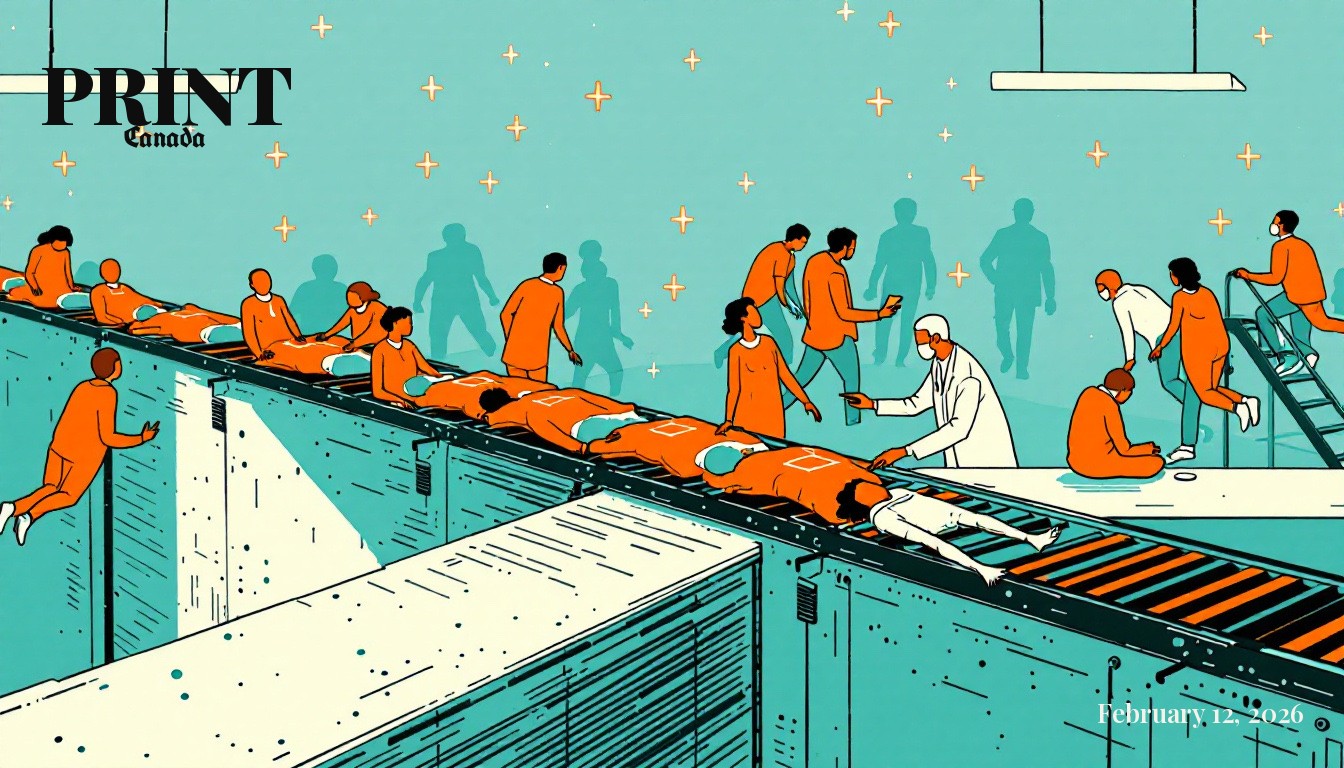
The crowded clinic, and the quiet crisis of the small thing.
The country has confused volume with care. Every walk-in chair is occupied. Every triage queue is long. The actually sick are folded in among the merely worried, and the system has stopped distinguishing between them. The unfashionable fix is the one nobody on a podium will say.
EdmontonThe Canadian medical clinic, in the year of our Lord two thousand and twenty-six, has the architecture of a fast-food restaurant and the productivity of a parish office. The chairs are full. The lights are bright. The pamphlets, which advertise vaccinations against diseases the country has not seen in fifty years, are arranged in tidy plastic racks. A clipboard moves from one set of hands to another. A name is called. A door opens. Behind the door, a doctor who has eleven minutes per patient and a screen that records seventeen fields decides, in a margin of error so narrow it is almost an art, what your morning is going to mean.
The country, when it talks about its healthcare system, talks about access. Access is the polite word. Access means: how many people can get in. The answer is: most of them, eventually, after a lot of waiting, into a room that is overcrowded, where the time they receive is too short to be care and too long to be triage. The country talks less, in the same conversation, about quality. Quality is the word the country has forgotten how to spell.
The arithmetic of the chair
What the system was designed to absorb, when it was designed, was illness. What the system has been trained to absorb, by sixty years of cultural drift, is anxiety. The two are not the same. The first kind of patient is sick and knows it. The second is uncertain and would like a professional to tell them whether they should worry, and the professional, generously and constitutionally, is required to find out. The finding-out takes a chair. Multiply the chair by forty thousand patients per province per day, and the math arrives at the same place every time. The serious are folded in among the worried. The doctor learns, after a while, to triage by demeanour rather than by data, which is not what the doctor was trained to do, and the doctor begins, gently, to dislike the work.
This is the structural fact the country has not managed to discuss. There is no villain in it. The patient with a cold is not malicious. The doctor with the eleven minutes is not callous. The system, which was supposed to filter, has stopped filtering, because the country never built the filter and is now too embarrassed to install it.
The unfashionable fix
The unfashionable fix is a sentence no minister of health will say in public, because the sentence sounds, to the politically attentive ear, like rationing. It is not rationing. It is calibration. Most of the people in most of the chairs in most of the clinics most of the time do not require a physician. They require a nurse, a pharmacist, a public-health phone line, a piece of paper that explains what to do for a sore throat, or, in many honest cases, a quiet room and three days of rest. The country has these resources. The country has not, at any point in the last thirty years, organised them in a way that allows the chairs to empty for the people who actually need them.
Quality is the word the country has forgotten how to spell.
What this would look like, in the imagined and unembarrassed version of the file, is plain. A patient in mild distress reaches a triage line and gets, at the other end, a registered nurse with twenty minutes and a protocol. The nurse, in most cases, resolves the matter or routes it to a pharmacist, who has, since 2023, the authority in this province and most others to manage a meaningful share of the conditions that crowd the front of the clinic. Only the patients whose conditions exceed those tools reach the physician. The physician, who is paid the same per patient as before, sees fewer patients. The patients she sees are sicker. Her time, when she gives it, is the kind of time the doctor became a doctor to give.
The country, gently
The country will not, in the next election cycle, hear the argument made in those terms. The country will hear, instead, that more clinics are being opened, that more nurses are being hired, that more money is being spent. The clinics will fill. The nurses will burn out. The money will be spent. The chairs will remain full. The serious patients will continue to be folded in among the worried. The doctors will continue, gently, to dislike the work.
It is possible to love a country and still tell it, in print, that it has miscalibrated the most expensive thing it builds. It is possible to want medicine to be free and still want it to be sharp. The two desires are not in conflict. The country has been told, for a generation, that they are. The country has believed it. The chairs are full because of the belief.
Empty the chairs. Train the nurses. Trust the pharmacists. Pay for the phone line. Tell the public, with the diplomacy of a country that respects its citizens enough to be honest with them, that the cold belongs at home and the broken arm belongs at the hospital, and that the system will work for both, separately, properly, the way it was always supposed to.