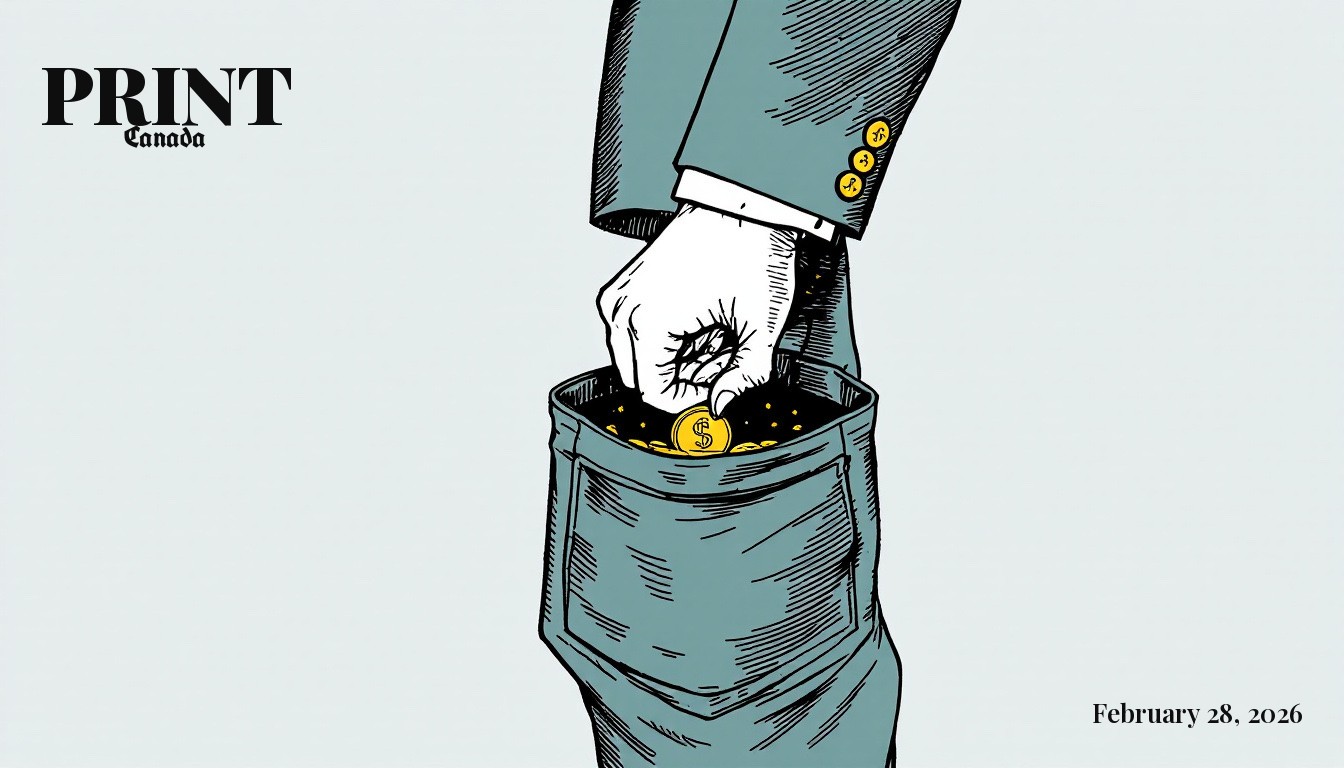
The fee that should not exist.
Overdraft is a tax on poverty, dressed in cufflinks. Repossession-without-warning is a violation of every principle of consumer protection most countries have written into law, written here only on a brochure. And the loan whose terms shift between the dealership floor and the financing desk is the small, perfectly engineered cruelty that the Big Five cannot, when actually questioned, defend. They have not been questioned in a long time. They should be.
TorontoThe Canadian banking sector is, by structure, the least competitive of any major sector in the country. Five firms, holding ninety percent of the deposits, with overlapping boards, identical fee schedules, and a regulator who is, by the kind of polite arrangement only a small country can sustain, mostly an alumnus of one of them. The arrangement is cordial. The arrangement is profitable. The arrangement is what the country has decided to call banking. The customer, who is the only party to the arrangement who did not choose it, is the customer the arrangement has the most contempt for.
This essay is about three of the contempt's most ordinary expressions. The overdraft fee. The repossession that arrives without notice. And the consumer loan whose terms move, between the dealership floor and the financing desk, in the bank's favour, while the customer is signing for a car they have already paid the deposit on.
Overdraft
Overdraft is the fee a bank charges a customer for not having enough money in the customer's account. The fee, on most accounts in this country, is between forty-three and forty-eight dollars per occurrence, plus an interest rate on the overdrawn balance that, annualised, exceeds the interest rate on most credit cards. The bank assesses the fee even when the customer's account, on the same day, is overdrawn by less than the fee itself. The bank assesses the fee even when the customer's pay deposit is in the same business day's processing queue and would, on any honest reading of the calendar, cure the overdraft by the close of business. The bank assesses the fee, in most cases, on the people in the country with the fewest dollars to spare.
The defence the banks have offered, in the rare instances they have been asked to offer one, is that the fee is a fair compensation for the credit risk of allowing the transaction to clear. This is not a serious defence. The credit risk on a thirty-eight-dollar overdraft is not forty-eight dollars. The credit risk on a thirty-eight-dollar overdraft is, in any actuarially honest accounting, less than a quarter, possibly less than a dime. The fee is not compensation. The fee is a tax. The tax is a tax on the people the bank, in any decent country, would be in the business of helping.
Most other G7 countries have either capped this fee, prohibited it, or required the bank to inform the customer in advance of the transaction. None of these reforms requires legislation more complex than a single page. None of them has been adopted in this country. The reason is that the country has not, in this generation of regulators, asked.
Repossession without warning
The second cruelty is the repossession that arrives without notice. The car loan, in this country, is governed by a patchwork of provincial law and federal consumer-protection statute that is, in most instances, weaker than the patchwork in any G7 country except the one to the south. The patchwork allows the lender, in most jurisdictions, to instruct a tow service to remove the vehicle from the borrower's driveway with no advance written notice in any case in which the borrower is more than a small number of days behind on a single payment. The borrower wakes up, in many of the cases this magazine has on file, to a missing car, and to a phone call from the impound lot that begins with a fee that, on its own, is greater than the missed payment that triggered the tow.
The defence, again, is risk. The defence is that the lender has the right to recover the collateral. The lender does have that right. The lender does not, however, have the right to recover the collateral without first attempting, in writing, to bring the borrower into compliance through any of the four or five mechanisms that exist for this purpose in better-regulated jurisdictions. The mechanisms are not exotic. A registered letter. A grace period. A re-amortisation. A hardship pause. A required telephone outreach. None of these is a radical proposal. None of them is the law in most provinces in this country. The lender, in most cases, can simply call the tow.
Overdraft is a tax on poverty, dressed in cufflinks.
The loan that moved
The third cruelty is the small, perfectly engineered one. The customer applies for an auto loan through the dealership's electronic platform on the day they sign for the vehicle. The platform produces, on a screen the customer reads in detail, a set of terms. Eighty-four months. A specific monthly payment. A specific interest rate. The customer accepts. The customer pays the deposit. The customer arranges the insurance. The customer travels to the dealership for the delivery. At the dealership, on a different screen, in front of a different person, with the vehicle visible in the window, the loan documents the customer is asked to sign carry a different number of months and a different monthly payment. The new terms are higher. The new terms are unexplained. The customer, who has paid the deposit and arranged the insurance and travelled to the lot, signs.
This is bait and switch. It has a name in every consumer-protection statute in every English-speaking jurisdiction. In this country, the courts will, eventually, on a particular borrower's facts, agree. Until they do, the bank that offered the original terms and the bank's dealership partner will continue to operate the bait and the switch as a quiet matter of process. This magazine has on file a case in detail, with screenshots, signed documents, and the difference in monthly payment to the dollar. The case is, at the time of going to press, in the country's small claims court. The court, when it disposes of the matter, will produce a precedent that, if any of this country's regulators chooses to read it, will shorten the lifespan of the practice considerably.
What would actually break the hold
The Big Five's hold on the country is not magic. It is the consequence of a regulatory environment that the country could change in a single legislative session if the country wished. A cap on overdraft. A required written notice before any consumer-credit repossession. A statutory cooling-off period for any consumer auto loan whose terms changed between application and signing. A regulator with a chair appointed from outside the sector. A new bank charter, available to any qualifying credit union or fintech, that could hold deposits without going through the existing five.
None of these is radical. All of them have been adopted, in some form, by countries the size and structure of this one. None of them will be adopted here in the absence of public pressure. Public pressure, in turn, requires the public to know that what is happening in their accounts is not the price of doing business. It is the price of a particular arrangement the country has not been asked to renew. The country, when it is asked, will not, in this magazine's view, vote to renew.
Ask the country.