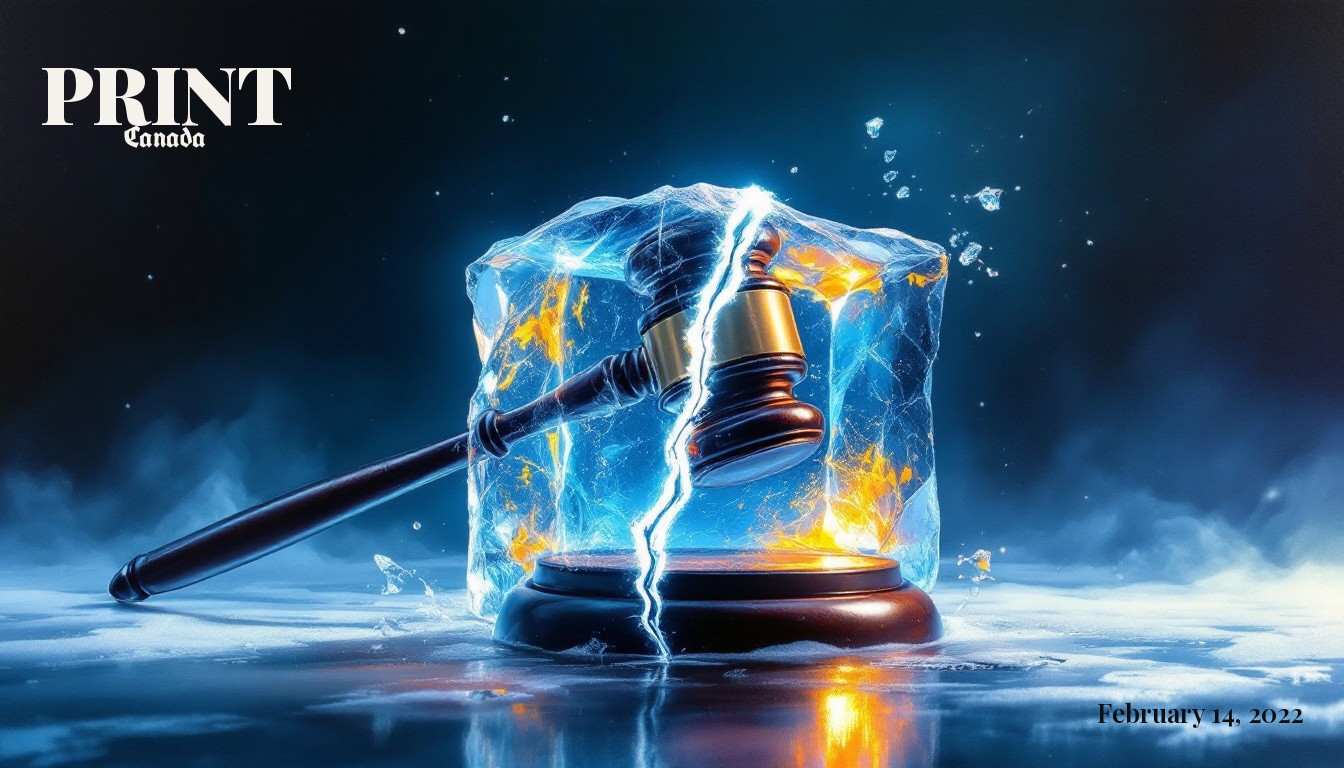
The first time Canada ever used the Emergencies Act.
On the fourteenth of February, 2022, the federal government reached for a power the country had never used and froze bank accounts, compelled tow trucks, and drew lines on the map citizens could not cross. A public inquiry later said the bar was met, but reluctantly. A Federal Court judge later said it was not met at all. Years on, the precedent matters more than the protest, and the law is still unsettled.
Ottawa.Set aside, for a moment, what you think of the people who parked their trucks in downtown Ottawa in the winter of 2022. The lasting question that February was never really about them. It was about what the government did in response, because on the fourteenth, for the first time since it was written in 1988, Ottawa invoked the Emergencies Act. A power the country had built and never once used was switched on, and it is worth being precise about what that power did. It let the state freeze the bank accounts of people connected to the protest without a court order. It let the government compel private tow truck operators to clear vehicles. It let officials designate areas that citizens were forbidden to enter. The Act stayed in force from the fourteenth to the twenty-third of February, nine days, and then it was revoked.
That is the thing to hold onto. Whatever you make of the blockade, the country crossed a line it had kept uncrossed for thirty-four years, and the important argument is whether it should have.
The inquiry, and a reluctant yes
The Act requires that its use be examined afterward, and so the Public Order Emergency Commission, led by Justice Paul Rouleau, did exactly that. It was a serious process, not a formality: thirty-one days of public hearings through the fall of 2022, seventy-seven witnesses, and a five-volume report delivered in February 2023. Rouleau's conclusion was that the government had met the very high threshold the law demands. But he did not reach it triumphantly. He said he came to the conclusion reluctantly, and he laid the deeper blame on what he called a failure of policing and of federalism, the breakdown of ordinary authorities that left the extraordinary one looking necessary. In other words: the powers were justified largely because everything that should have prevented their need had already failed.
A commission said the threshold was met, reluctantly. A Federal Court judge later said it was not met at all, and that the use breached the Charter. The country still does not have a settled answer to whether its first use of emergency powers was lawful.
Then a court said no
Here is the part that keeps the question open, and that a fair account cannot leave out. A public inquiry is not a court, and the civil-liberties organizations that intervened, among them the Canadian Civil Liberties Association and the Justice Centre for Constitutional Freedoms, said so at the time: the Commission could weigh the politics, but only a judge could rule on the law. A judge did. In January 2024, the Federal Court found that the invocation had been unreasonable and had violated Charter protections, including the guarantee against unreasonable search and seizure that the account freezes engaged. The government is appealing that ruling. So the country now holds two official answers that point in opposite directions, an inquiry that said yes and a court that said no, and the final word still sits somewhere up the appeal ladder.
Why this outlives the convoy
It is tempting, depending on your politics, to file this entirely under the convoy and move on. That is the mistake. Emergency powers are not dangerous because of who they are used against first. They are dangerous because the first use is the one that makes the second use thinkable. A government that has frozen accounts once, and been told by an inquiry that it was within bounds, has a template. The protections that matter are the ones that hold when the people on the receiving end are unpopular, because that is the only time those protections are ever tested. The Charter's promise is not that protest is unlimited. It is that the state cannot suspend the ordinary rules without a genuinely extraordinary reason, and that a court, not just a commission, gets to decide whether the reason was real.
The verdict
The honest position, four years on, is the uncomfortable one: the law is not settled, and anyone who tells you it is, in either direction, is telling you their politics rather than the record. What is settled is the precedent. The Emergencies Act is no longer a theoretical instrument kept in a glass case. It has been used, and the country has learned that it can be used, and that an inquiry may bless the use even as a court condemns it. That is the inheritance of February 2022, and it belongs to everyone who might one day be on the wrong side of a power the rest of the country is content to see deployed.
A retrospective published in 2026. Drawn from the public record: the invocation of the Emergencies Act on February 14, 2022, in force until February 23; the Public Order Emergency Commission's hearings (October to December 2022, 77 witnesses) and five-volume report of February 17, 2023, which found the threshold met; and the January 2024 Federal Court decision finding the invocation unreasonable and a Charter breach, now under appeal. Commentary on the civil-liberties record, not legal advice.