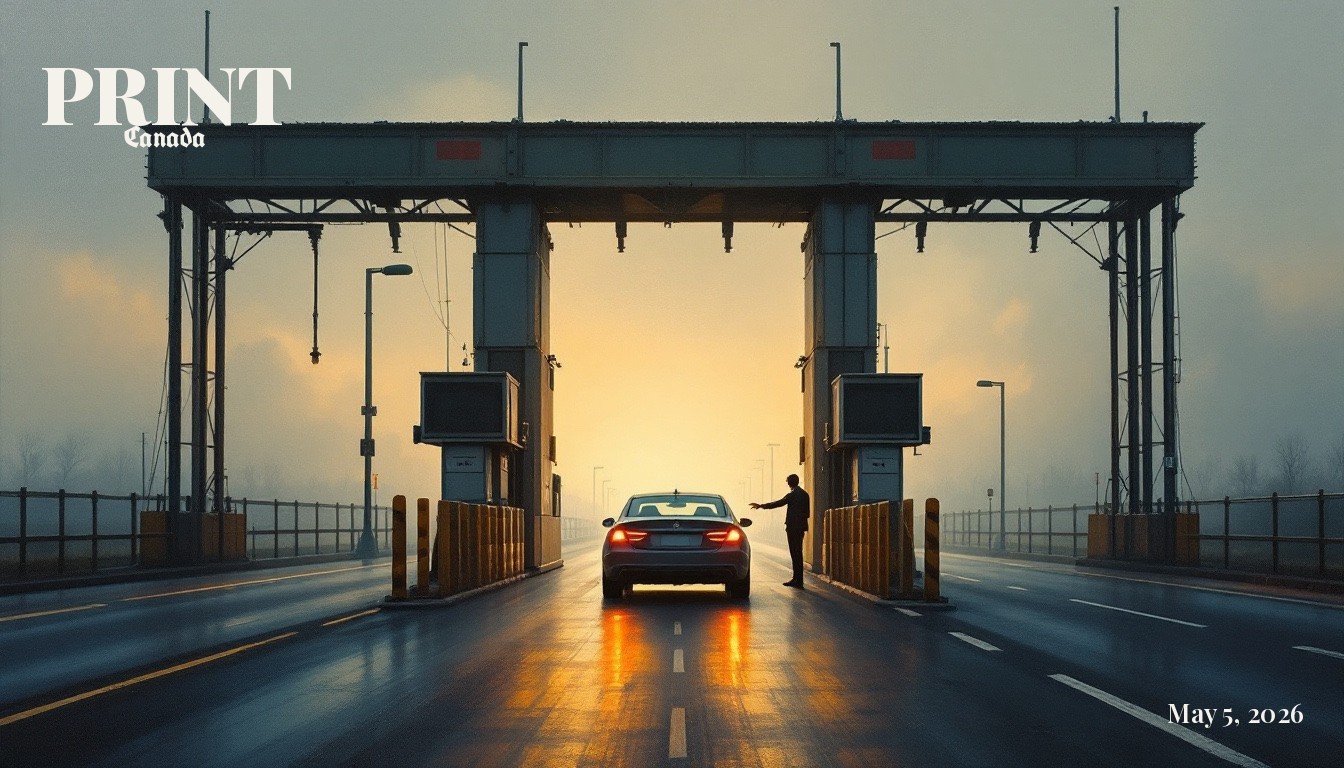
The mandatory tax we call insurance.
Ontario law requires every driver to buy auto insurance from a small set of large companies that compete with each other on advertising and on almost nothing else. The price, in the cities where the country's driving actually happens, is now higher than the monthly payment on the car. The arrangement is, in plain English, a mandatory tax administered by private firms. The country has, on its own ledger, no excuse for it.
TorontoIn Brampton, in Mississauga, in much of Scarborough, in the parts of the city of Toronto the average renter can still afford to live in, the average monthly cost of automobile insurance for a driver under thirty is, by the Insurance Bureau of Canada's own most recent figures, higher than the average monthly payment on a five-year-old used car. This is not a controversial statistic. The Bureau publishes it. The province's own Financial Services Regulatory Authority publishes it. The brokers, when asked, will confirm it without prompting. The country, when it considers the statistic at all, treats it as a fact of nature. It is not a fact of nature. It is a fact of policy. The policy was written by the legislature, lobbied by the industry, and signed off by every cabinet of every governing party in this province since the 1990s.
What the policy does, in operational terms, is the following. The province requires, by law, that every motor vehicle on its roads carry liability insurance to a defined statutory minimum. The province permits, by parallel legislation, this insurance to be sold only by a small set of large private firms whose entry into the market is gated by regulatory capital requirements that no new entrant has cleared in this generation. The province then permits those firms to set their own rates, subject to a regulator who approves nearly every rate filing the firms submit. The driver, who is required to buy, has no comparable lever. The firm, which is required to sell, has every lever the legislature has been willing to surrender.
The excuse
The industry's stated reason for the rate level in this province is risk. Ontario, the industry will say, has the country's worst record on uninsured collisions, the country's most expensive fraud problem, the country's highest medical-rehabilitation costs after a serious crash, and the country's most aggressive plaintiff's bar. Each of these claims is partly true and partly self-serving. The fraud problem, on the industry's own audited figures, has been declining for a decade. The medical-rehabilitation costs are recoverable from the public health system in most jurisdictions and are not, in any honest accounting, the marginal driver of premium. The plaintiff's bar is doing the job a plaintiff's bar is supposed to do. The uninsured-collision rate is partly a consequence of the premium level itself, in a country where a driver who cannot afford the policy will, in too many cases, drive without it and hope.
The industry's actual reason for the rate level is that the law obliges the citizen to buy. A market in which the buyer has no choice and the seller has limited competition is not a market. It is a tariff. The country has not, in any quarter, called it a tariff. The country has called it insurance. The vocabulary has been doing a lot of work.
A public option for the people the system has priced out
Three Canadian provinces operate a public auto-insurance plan. Saskatchewan, Manitoba, and British Columbia have, for between forty and seventy years, run state-owned insurers that provide the basic mandatory coverage to every driver in the province. The rates in those provinces are, on every comparable metric the Bureau publishes, between fifteen and forty percent lower than Ontario's for an equivalent profile of driver. The systems are not perfect. The systems are also not the private oligopoly. Whatever one thinks of the public model in the abstract, the public model has demonstrably delivered the same product to the same population at a lower price for a generation.
The country has not, in any quarter, called the arrangement a tariff. The country has called it insurance. The vocabulary has been doing a lot of work.
The unfashionable proposal, in this province, is not full nationalisation. It is a public option, available to drivers below a defined income threshold, providing the statutory minimum coverage at cost-plus pricing, administered by a Crown corporation with a board that does not contain anyone who has worked at the Big Three in the previous decade. The proposal would not, on any honest projection, bankrupt the existing industry. It would, however, remove from the industry the captive low-income population that the current pricing structure most heavily extracts from. The industry would be obliged, in response, to lower its rates to retain the rest of its book. The driver, in the end, would be paying less. The province would, in the end, have a tool. The lobbying against the proposal will be, when it arrives, ferocious.
What this magazine asks
Stop hiding behind compulsory-coverage law to charge whatever the market will bear. Publish, in plain language, the per-driver profit margin in each of the five postal-code clusters the Bureau already breaks the province into. Publish, in plain language, the regulator's rate-filing approval ratio for each of the Big Three over the last ten years. And put the public-option file on the desk of the next finance minister with the political courage to read it. The country has been told, for thirty years, that this file is too complex to touch. The file is not complex. The file is just expensive to the firms that have been writing it.