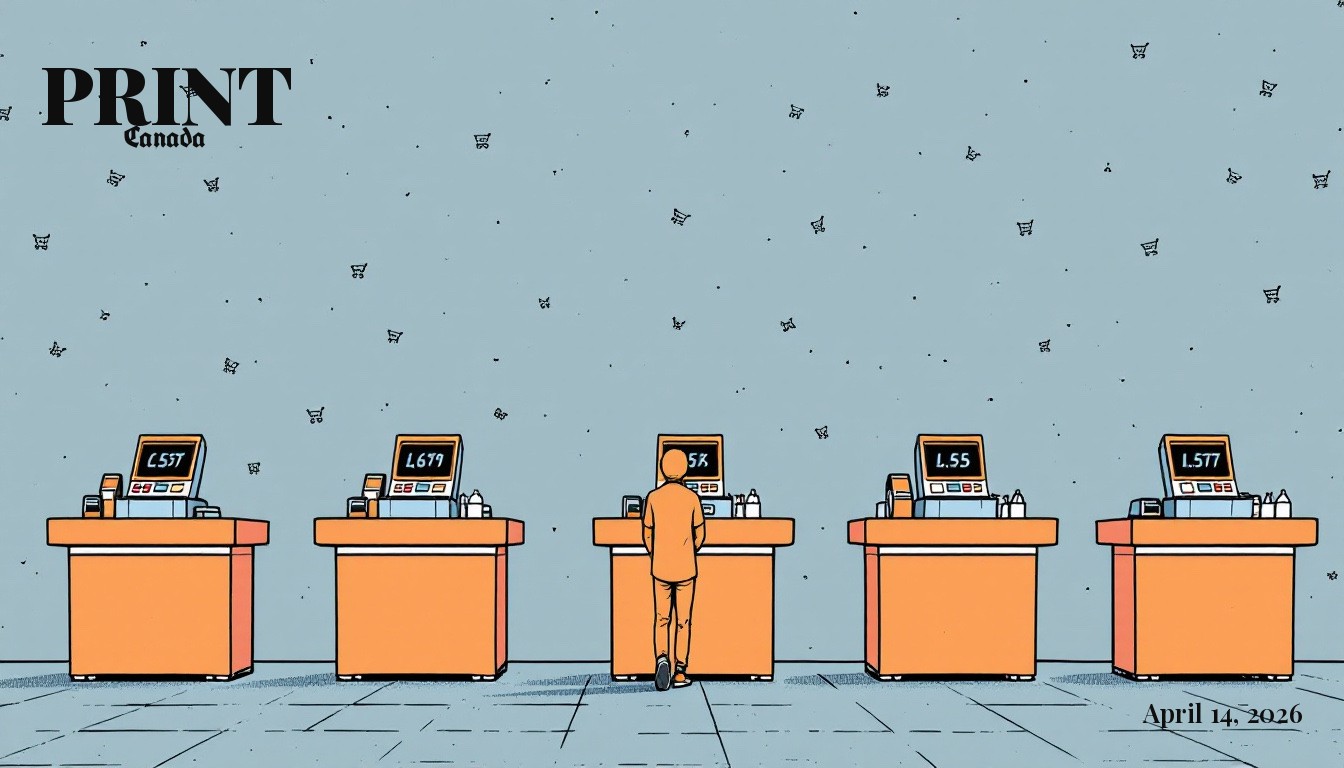
Five chains, and the most expensive country in the developed world to eat in.
Loblaw, Sobeys, Metro, Empire, and Costco. Five firms control more than ninety percent of the country's grocery market. The price of food in Ontario, by every available international comparison, is now the highest in the developed world. The country has, in the absence of competition, been left alone with five chains. The five chains have, in the same absence, done what oligopolies always do.
WinnipegThe price of food in this country, taken across the basket of staples the OECD compares between member economies, has been the highest in the developed world for the better part of three years. The Bank of Canada has, in three of its most recent monetary policy reports, flagged the grocery-inflation anomaly as a category that has consistently diverged from the country's general consumer price index. The Bureau of Competition, in two parallel reports, has described the country's grocery sector as one of the most concentrated retail markets in any G7 economy. The country, when it confronts these facts at a kitchen table on any given Tuesday, blames vague global trends. The global trends are real. They are not, on the available numerical evidence, why the country pays what it pays.
The reason the country pays what it pays is, in plain English, that five firms control over ninety percent of the grocery market in this country. Loblaw Companies Limited, through Loblaws, No Frills, Real Canadian Superstore, Shoppers Drug Mart, T&T, and Fortinos, holds the largest share. Sobeys, through Sobeys, Safeway, IGA, FreshCo, Foodland, and Farm Boy, holds the second. Metro, through Metro and Food Basics, holds the third. Empire, on certain rolling accountings, holds part of the Sobeys share through ownership. Costco, the only non-Canadian member of the set, holds the remainder. There is no other meaningful retail chain in the country. The independent grocery store, as a category, accounts for less than seven percent of consumer spending in a typical Canadian census metropolitan area.
What concentration produces
An oligopoly of this size, in any sector, produces predictable outcomes. Coordinated pricing. Coordinated procurement. Squeezed suppliers. Price-matching that is, on the surface, generous to consumers but is, in practice, a mechanism for ensuring that no chain's price meaningfully diverges from any other chain's. Promotional pricing that creates the appearance of a sale without lowering the average basket cost over a quarter. Private-label expansion at margins higher than the branded equivalents they displace. Vertical integration into pharmacy, gasoline, financial services, and real estate, each of which extracts an additional small margin from the consumer's wallet through the same loyalty system. None of these practices is, on its own, unlawful. All of them, taken together, describe the operating reality of a sector that the country's competition regulator has not seriously challenged since the early 1980s.
The reason the regulator has not challenged is partly statutory and partly cultural. The Competition Act, in its current form, is one of the weaker antitrust instruments in the G7. The Bureau, by the Act's own design, must prove harm to competition by a standard that the country's own competition lawyers describe, off the record, as effectively unprovable in any sector this large. The Bureau's recent inquiries into the grocery sector have produced reports. The reports have produced press releases. The press releases have produced no enforcement.
The reports have produced press releases. The press releases have produced no enforcement.
The bread-price-fixing settlement nobody talks about anymore
In 2018, after a multi-year investigation, several of the country's largest grocery chains acknowledged participation in a price-fixing arrangement on packaged bread that had operated, by the chains' own admission, for fourteen years. The arrangement had inflated the price of bread by a documented amount during the period in question. The chains paid a settlement. The settlement was, in the country's vocabulary, large. The settlement was, on the math of the chains' actual revenue over the period, modest. The chairs of two of the chains involved kept their seats. No senior executive was personally charged. The country, in the years since, has continued to buy bread from the same chains. The bread is more expensive than it was when the cartel ended.
What the country could choose, by the next federal budget
A serious country with a serious grocery problem would do four things, none of them novel. First, it would amend the Competition Act to lower the standard of proof for anti-competitive conduct in highly concentrated retail markets. Second, it would empower the Bureau to compel divestiture in any merger that increased concentration in a Census Metropolitan Area beyond a published threshold. Third, it would create a dedicated grocery ombudsman, modeled on the United Kingdom's Groceries Code Adjudicator, whose mandate would be to receive supplier complaints and to publish findings within a fixed timeframe. Fourth, it would tilt the public procurement system toward independent grocers in school-meal, hospital, and prison food contracts at a meaningful scale, to provide the demand floor under which an independent grocery sector could plausibly survive.
None of these is a moonshot. All of them are present, in some form, in comparable jurisdictions. The country has not implemented any of them at meaningful scale. The country has, in the absence of the implementation, allowed five firms to set the price the country pays for the food the country eats. The country, on its own published numbers, now pays more for that food than any peer economy.
A modest demand
The country could decide, in the next federal budget, that the grocery file is a competition file rather than an inflation file. The two are related but they are not the same. The inflation file is the Bank of Canada's. The competition file is the Bureau's. The Bureau has, on this file, the tools it has been given. The country has, in its legislative power, the ability to give the Bureau better tools. The country has not chosen to. The country, in the meantime, will continue to be the most expensive country in the developed world to feed a family of four. The country has decided to call this normal. It is not normal. It is the outcome the country has, in its non-action, selected.