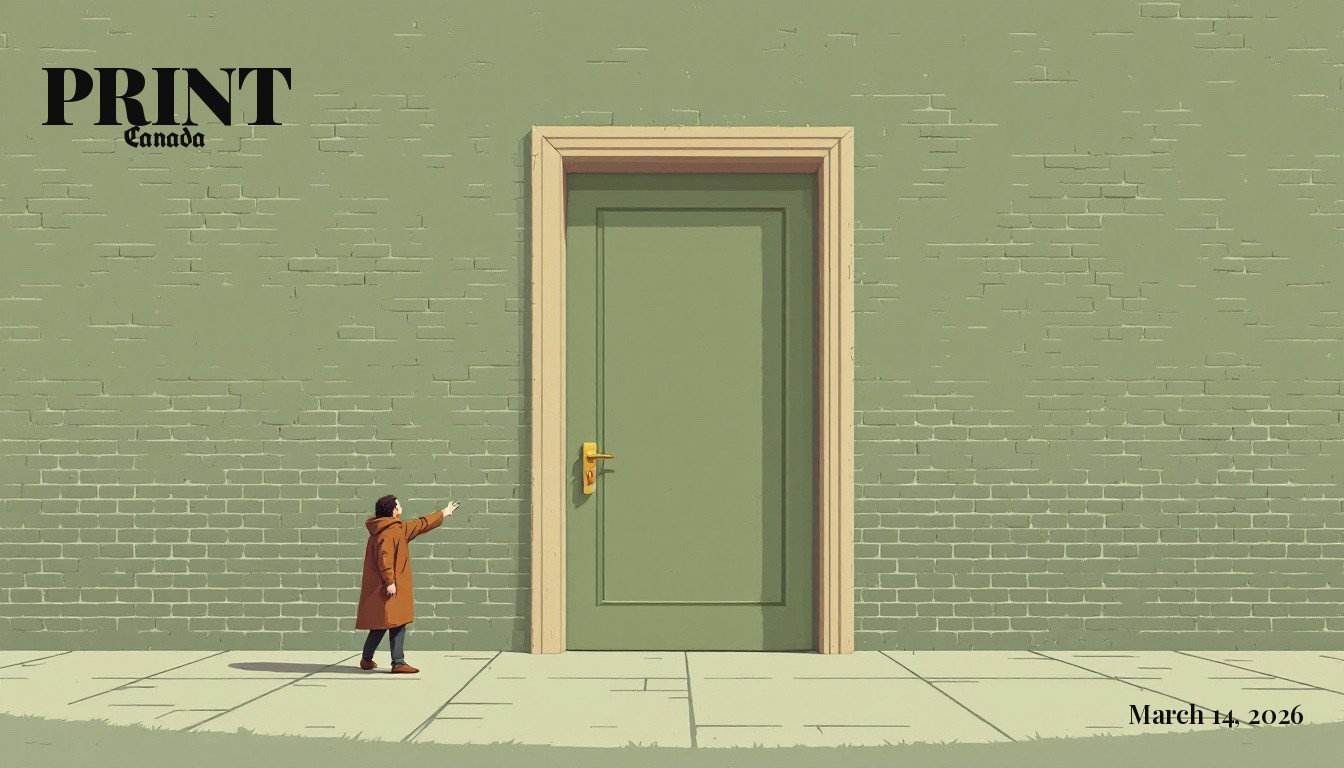
The pretence at the front door.
The country has, since the early 2010s, told itself that it cares about mental health. The country has produced a great many ribbons, posters, and corporate-sponsored awareness days. The country has not produced a public counselling system. Anyone who has tried, in the public system, to get a regular hour with a therapist knows the truth. There is no hour. There is, instead, a private fee schedule and a polite suggestion to consider it.
EdmontonThe country, in the second decade of this century, decided that it had a mental health problem. The decision was correct. What followed the decision was a wave of cultural acknowledgment that, on its face, was the appropriate response. Posters. Ribbons. Hashtags. Workplace seminars. A rotating set of athletes and musicians and television presenters speaking, with appropriate gravity, about their own struggles. A national day of conversation, sponsored by a telecommunications company, on which the country was encouraged to ring its mother, hug its colleague, and donate the price of a coffee.
What did not follow the decision was a public counselling system. The country did not build the system because the country never decided to fund the system. The country did not fund the system because the country did not, in the moment of its acknowledgment, want to commit the budget the system would have required. The country, in the place where the system would have been, built a pretence. The pretence has, for ten years, been the country's primary deliverable on the file the country said it cared about most.
The shape of the pretence
The pretence has a familiar shape. A citizen, in distress, decides to seek help. The citizen calls their family doctor, if they have one. The family doctor, who has eleven minutes, listens for six and prescribes, on the seventh, a referral to a psychiatrist or, in many cases, a selective serotonin reuptake inhibitor at a dose calibrated to the average patient. The psychiatry referral, in most provinces, will be honoured in nine to twenty-four months. The medication, if accepted, will be filled at the pharmacy by the end of the day.
What the citizen actually wants, in the great majority of these cases, is not a psychiatrist and not a medication. The citizen wants a therapist. The therapist, by definition, is a clinician trained in talk therapy: cognitive behavioural therapy, dialectical behaviour therapy, narrative therapy, psychodynamic therapy, depending on the school and the file. The therapist, by demonstrated effectiveness on the country's own clinical evidence, would resolve, manage, or significantly improve the citizen's condition in a meaningful share of the cases. The therapist, in the country's public health system, is almost entirely absent.
What the citizen will be told, when they ask, is that therapy is not, in any province in this country, covered by the public health plan. The citizen will be told to consider their employer's benefits, which, in most cases, cap counselling at five hundred or one thousand dollars per year, which, at the going rate of one hundred and ninety dollars per session, is between two and five sessions. The citizen will be told, if they have the means, to pay out of pocket. The going rate, again, is one hundred and ninety dollars per session. The recommended course of treatment, for most conditions, is sixteen to twenty-four sessions. The citizen, in any honest reading of these numbers, has been told to pay between three and five thousand dollars for the treatment the country said it cared about them having.
What the country actually built
What the country actually built, in the place where the public counselling system would have been, was a private market. The private market is, in most provinces, large, professional, and, on the practitioner side, well-trained. The private market is also, on the consumer side, the most regressive market in the country's healthcare landscape. The wealthy can afford the recommended course. The middle can afford a few sessions. The poor cannot afford the consultation. The country, which built a public hospital system in the 1960s on the principle that nobody should have to choose between their health and their savings, has, on the mental health file, allowed exactly that choice to become the operating norm.
The pretence is what makes it bearable, in the political sense, to allow the operating norm to continue. The pretence says: the country cares. The pretence says: the resources are there. The pretence says: the conversation is open. The pretence does not say: the resources are, in any sense the consumer can use, not there. The pretence does not say: the conversation is open in the same way that the conversation about housing is open. The conversation has been going on for thirty years. Nothing has been built.
The country, on the mental health file, has allowed exactly the choice the public hospital system was built to prevent.
The unfashionable proposal
The unfashionable proposal is the obvious one. Add psychotherapy, in a defined and clinically reasonable course of treatment, to the public health insurance plan in every province. The cost, on the actuarial analysis the country's mental health commission produced in 2012 and updated in 2020, is recoverable in seven to nine years through reduced presentations to emergency departments, reduced absenteeism, and reduced disability-claim costs in the public sector alone. The cost is, in the year of implementation, between four and seven percent of the existing provincial health budget, depending on the province. The cost is also, in any honest comparison to the per-capita expenditure on, for example, a single highway interchange in any major city, modest.
The country has not produced this proposal because the country, on the mental health file, has chosen instead to produce posters. The posters cost, on the production side, almost nothing. The posters allow the political class to claim that something is being done. The posters do not, however, treat any patient. The posters do not, at any moment, place a clinician in a room with a citizen in distress. The posters are the deliverable. The deliverable is, in any honest accounting of what the country actually said it cared about, a fraud.
A small, clarifying paragraph
A country that says it cares about a thing, and does not build the institution that the thing requires, does not care about the thing. This is a hard sentence. It is also, on the available evidence, the right one. The country, on the mental health file, has had a decade. The decade has produced posters. The next decade will, on present trajectory, produce more posters. The citizen in the chair, the chair this magazine has photographed for this article, will continue to wait for an appointment that will never be scheduled, in a system that has been quietly designed not to schedule it.
Build the system.