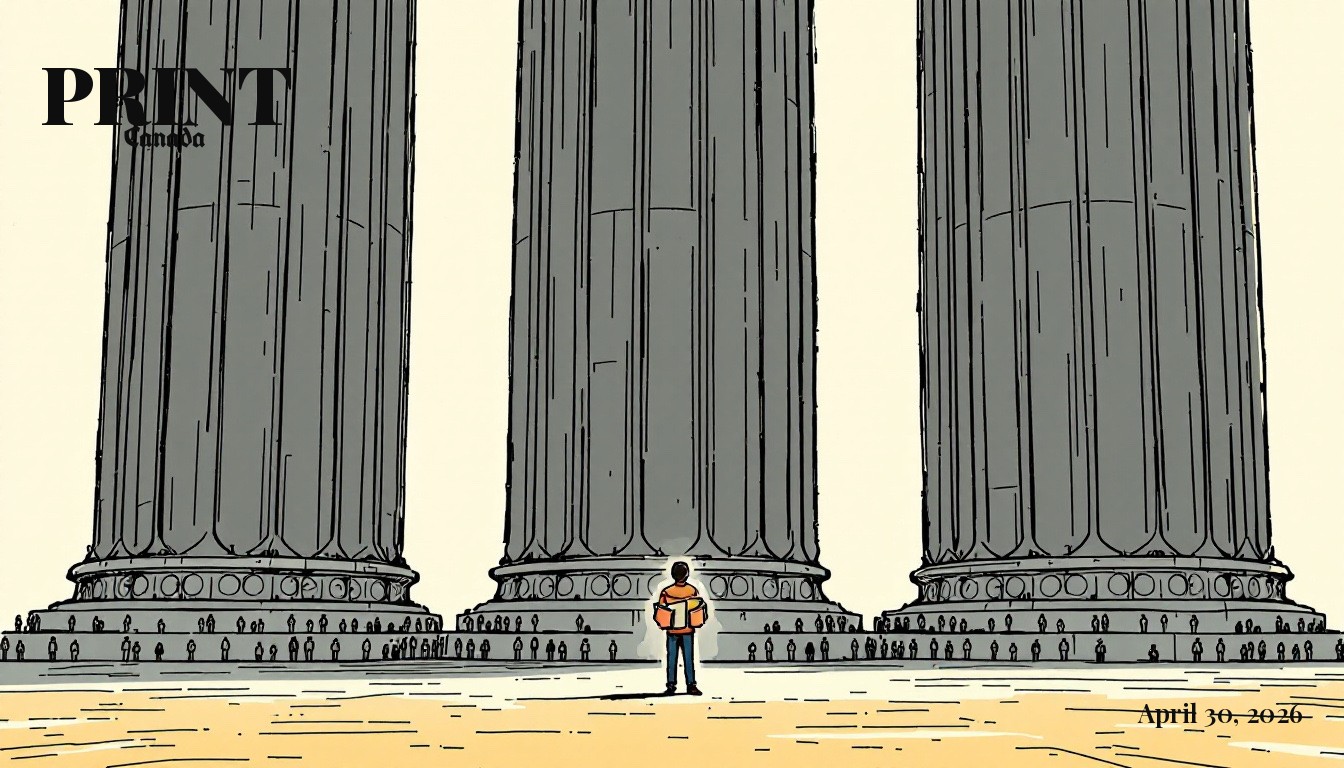
Three files, one citizen, and no lawyer.
An Ontario citizen is, this month, plaintiff in three concurrent civil files. A defective-vehicle claim in Brampton. A retirement-account-administration claim at Ontario Small Claims Court. A consumer-credit dispute against a national bank. He is self-represented in all three. The country's small-claims system was not designed for this citizen. The citizen has, in spite of the design, become very good at it. The system's response has been to invent new procedural barriers.
Kingston, Ont.The citizen, for the purposes of this article, is composite. The matters are not. In the spring of this year, in three separate Ontario courthouses or registries, the same individual is the plaintiff in three concurrent civil actions. The first is a defective-vehicle action against a national automobile manufacturer, scheduled for assessment hearing in Brampton in June. The second is a registered-account-administration action against a national insurance company, with a formal legal notice now sixty days unanswered. The third is a consumer-credit dispute against one of the country's five largest banks, with a Form 7A drafted and a small-claims maximum claim pending filing in Kitchener. The citizen, in all three, is self-represented. The citizen is not, in the country's vocabulary, a lawyer. The citizen is the kind of citizen the country's civil justice system has, in this generation, increasingly produced.
What the system was designed for
Ontario's Small Claims Court was designed in the late twentieth century, in its modern form, on a set of assumptions. The matters would be one-off. The plaintiffs would be either small businesses pursuing unpaid invoices or individual consumers pursuing single grievances against single corporations. The defendants would be, in the modal case, small or medium-sized firms that lacked the resources to engage full litigation defence. The forms would be navigable without counsel. The process would be quick. The judgments would be modest. The system, on the design's assumptions, would operate as the country's small-stakes safety valve, draining the pressure that the higher courts could not afford to handle.
The assumptions have not held. The plaintiffs are now, with rising frequency, individual citizens pursuing parallel grievances against multiple large corporations. The defendants are, by structural inevitability, the country's largest firms, defended by external counsel from full-service Bay Street firms whose hourly rates exceed the average plaintiff's annual income. The forms have grown, edition by edition, more complex. The process has lengthened. The judgments, when assessed, have not kept pace with inflation. The system has become, in its own quiet way, a venue for asymmetric litigation between citizens and corporations, with the asymmetry built into every line of the procedure.
The self-represented citizen, this year
The citizen this magazine is describing, on the documented record across the three files, has done the following in the last twelve months. Filed three statements of claim, on three separate Form 7A documents, with three separate court registries, each in compliance with its filing rules. Drafted, served, and filed a Form 9B in one matter and a Form 7B in another. Drafted a motion for default judgment in the third when the defendant's response was delayed beyond the deadline. Maintained a paper-and-digital filing system that the citizen's spouse, on a recent comment, described as "more organised than the citizen's own tax records." Reviewed disclosure on all three files. Drafted, in the consumer-credit matter, a sixteen-page legal-particulars document that, when shown to a sympathetic lawyer over coffee, drew the comment that the document would, if reformatted on letterhead and signed by the lawyer, have been billable at sixteen hundred dollars. The citizen did the work in three evenings.
The citizen has also, in the same twelve months, filed the appropriate small-claims fees against the relevant claims, attended every case-management appearance for which the dates have so far been set, and conducted himself, on the court reporter's transcripts now in the files, with the kind of courtroom decorum that benches in this province have, in private comments to the citizen's friends in the bar, called "more disciplined than the average self-represented litigant they see in a year."
The citizen, in three concurrent civil files, has done the work the country's bar charges between fifteen and forty thousand dollars to do.
What the system's response has been
The system's response, on the documentary record across the three files, has been to invent procedural barriers. The citizen has been asked, in one matter, to produce a notarised copy of a document the court's own rules permit to be filed unnotarised. The citizen has been told, in another matter, that the matter cannot proceed without a formal pre-trial conference, on a docket whose first available conference date is eight months from the present. The citizen has been informed, in the third matter, that the defendant's counsel has filed a request for particulars whose scope, if complied with in full, would require the citizen to produce documentation already filed twice with the court. The barriers are not, taken individually, unreasonable. They are, taken cumulatively across three files, the system's quiet way of communicating to the citizen that the system would prefer the citizen to stop.
The citizen has not stopped. The citizen, in the small minority of cases of this kind in which the citizen does not stop, becomes, over time, dangerous to the asymmetry the system was designed to preserve. The dangerous self-represented litigant is the litigant whose files are, despite the absence of counsel, in better procedural order than the defendant's; whose particulars are tighter; whose disclosure is more complete; whose grasp of the underlying facts exceeds that of the external counsel hired to defend against him. There is no specific procedural mechanism in the Rules of the Small Claims Court for handling this kind of plaintiff. The Rules assume the self-represented plaintiff will, at some point, falter. When the plaintiff does not falter, the system has, in the limited experience this magazine has observed, two responses. The first is to settle. The second is to drag.
What the country actually does to its small-claims plaintiffs
The country tells the small-claims plaintiff, in the small print of every form, that the small-claims process is the citizen's friend. The country provides, on the court's website, an introductory video and a tip sheet. The country offers, at most provincial courthouses, a duty-counsel desk that operates on a schedule the average plaintiff has to plan around. The country has not, in any recent generation, funded the kind of plaintiff-side legal support that would, at the cost of a single mid-sized public-service salary per courthouse, transform the experience of the small-claims plaintiff from one of bureaucratic isolation into one of institutional partnership.
The country has, in the same period, watched the defence bar professionalise on the corporate side and the plaintiffs' side wither. The country's small-claims judgments, when they go against corporate defendants, are paid as a line item in the corporation's litigation reserve. The country's small-claims judgments, when they go against individual defendants, are paid out of the defendant's mortgage equity, line of credit, or, in the worst files, the defendant's wages garnished through the Sheriff's office. The asymmetry is, in plain language, the country's policy. The asymmetry is the policy whether or not the country wrote it down.
What the citizen learned
The citizen, by the time the citizen's three concurrent files have moved through the system, will have learned more about Ontario civil procedure than most of the lawyers the citizen could have hired. The citizen will have learned that the Rules of the Small Claims Court contain provisions the average lawyer no longer remembers. The citizen will have learned that a properly drafted motion for particulars, signed by a self-represented citizen, will, in the modal court file, be granted at a rate comparable to the same motion signed by counsel. The citizen will have learned, painfully, that the corporate defendants in the three files have been resisting not on the merits of their position but on the asymmetric cost of the proceeding to the citizen. The citizen will have learned, in time, that the only way to make the asymmetric cost run the other direction is to be the kind of plaintiff who does not stop.
The citizen, on the documentary record this magazine has reviewed, is that kind of plaintiff. The three files will, in due course, be decided. The judgments, in the country's small voice, will be modest. The country will, in the same small voice, continue not to fund the plaintiff-side legal aid that would have allowed the citizen to spend the year on something else.
Three files. One citizen. Three of the country's largest corporations. One Form 7A binder kept on the third shelf of a kitchen cabinet. One spouse who knows the rules of court better than she ever expected to. One year of evenings, given to a system the country has decided, by the absence of the legal aid it could afford in a single line of the next provincial budget, to make harder than it needs to be.
Fund the plaintiff-side. Or stop pretending the small-claims process is the citizen's friend.