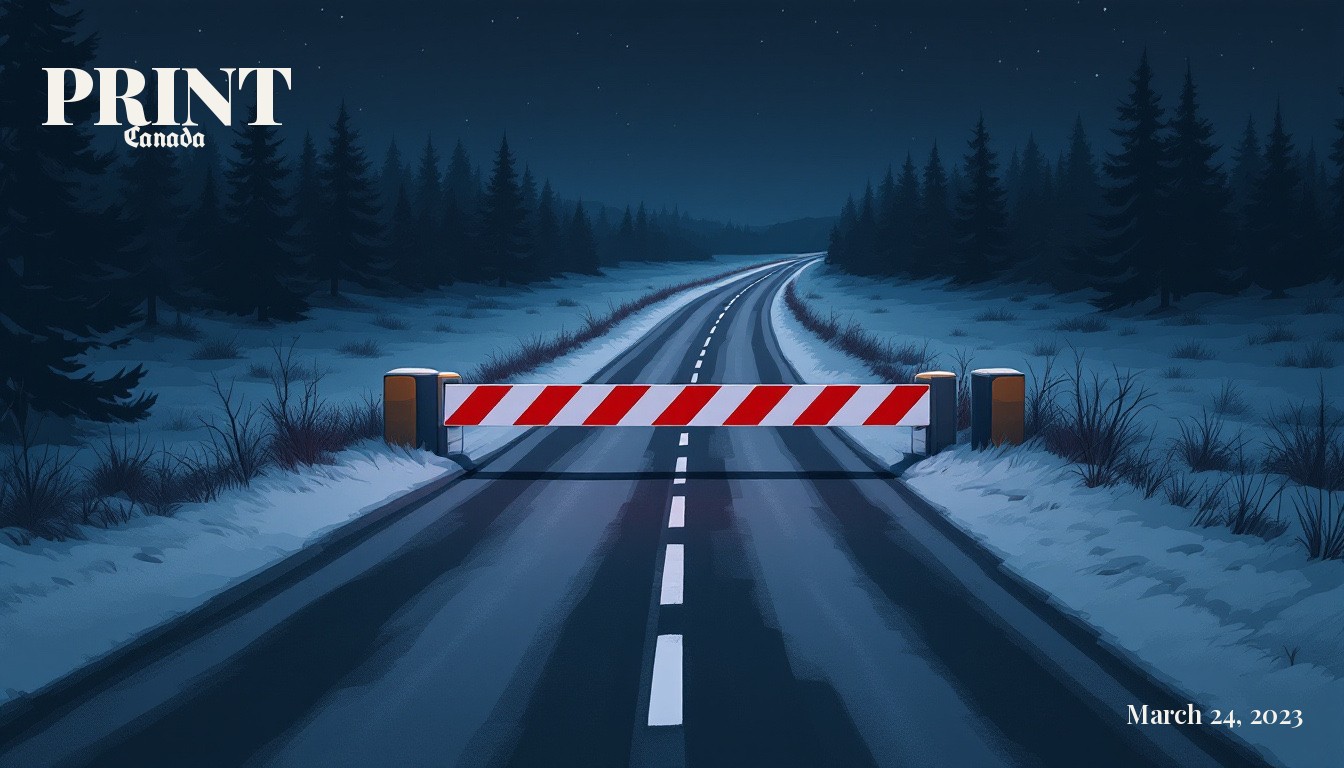
They closed the road overnight. The crossings did not stop, they moved.
Roxham Road was shut by a deal signed in a day and in force by midnight. What changed was not whether people cross, but where, and at what risk.
Saint-Bernard-de-Lacolle, Que.For six years a gravel road in rural Quebec was the most famous border crossing in the country. Roxham Road ran from a dead end in upstate New York to a ditch and a treeline on the Canadian side, and people walked across it to claim asylum. They did this because of a loophole. The Safe Third Country Agreement said a refugee claimant arriving from the United States could be turned back at an official border post, but the rule applied only at official ports of entry. Walk across between them, on a road like Roxham, and you could not be turned back the same way. So tens of thousands did. By the time it was closed, more than 100,000 people had entered Canada through that one crossing.
On March 24, 2023, that ended, and it ended fast. Prime Minister Justin Trudeau and United States President Joe Biden announced a deal to expand the Safe Third Country Agreement so that it applied across the entire land border, official posts and irregular crossings alike. The change took effect at midnight, the night of the announcement, deliberately giving no window for a rush of last crossings. With the loophole gone, the traffic dropped almost immediately, and the crossing was shut for good on March 25.
What the new deal actually says
The expanded agreement lets either country send back, to the other, a person who crosses the land border irregularly and claims asylum, provided they are intercepted within 14 days of crossing. In plain terms, walking across the border between official posts no longer gets a claimant past the rule. With narrow exceptions, a person arriving from the United States by land can no longer make an asylum claim in Canada, whether they show up at a booth or in a field. In exchange, Canada agreed to take in 15,000 people a year through legal channels from elsewhere in the Western Hemisphere.
A closed road is a clean image for a government. It is much less clean for the person who now has to find a longer, colder, less visible way across.
The objection, stated plainly
Migrant advocacy groups did not dispute that the deal would empty Roxham Road. They disputed that emptying it solved anything. Their argument, made at the time, was that closing one known and relatively monitored crossing does not reduce the number of people who need to flee. It pushes them to routes that are more remote, more dangerous, and run by smugglers, the kind of crossing where people die in winter fields rather than walk up a graded gravel road in view of waiting officers. The phrase that recurred in the criticism was that people would simply cross somewhere else. That is not a prediction that needs much faith. It is what tends to happen when a single visible crossing is sealed and the underlying pressure is not.
There is a second objection worth stating with the same care. The Safe Third Country Agreement rests on the premise that the United States is a safe country for asylum seekers in which they can fairly make their claim. That premise has been contested in Canadian courts and by refugee lawyers for years, on the basis that some claimants returned to the United States face detention rather than a fair hearing. Expanding the agreement does not resolve that contest. It extends a rule whose central assumption was already under challenge.
The verdict
Closing Roxham Road was, on its own terms, a success. The crossing it targeted closed within a day. But the goal of a border policy is not to close a particular road. It is to deal humanely and lawfully with people who arrive seeking protection. On that larger measure the deal did something narrower than it appeared to. It made an irregular flow invisible rather than absent, and it deepened a country's reliance on a premise, that the United States is uniformly safe for refugees, that its own courts have not been willing to treat as settled. The road is quiet now. That quiet is not the same thing as a solution.
This piece sits alongside our coverage of the closed work permits that bind migrant workers to a single employer, the international students courted and then blamed, and the Afghan resettlement promise and the years it took to keep it.
A retrospective published in 2026. Drawn from the public record: the March 24, 2023 announcement by Prime Minister Trudeau and President Biden expanding the Safe Third Country Agreement to the full land border, in force at midnight that night; the permanent closure of the Roxham Road crossing on March 25, 2023, after more than 100,000 people had crossed there; the 14-day return provision; Canada's commitment to admit 15,000 people annually from the Western Hemisphere through legal channels; and the documented objections of migrant-rights organizations that the closure would redirect crossings rather than reduce them. Commentary on the public record, not legal advice.