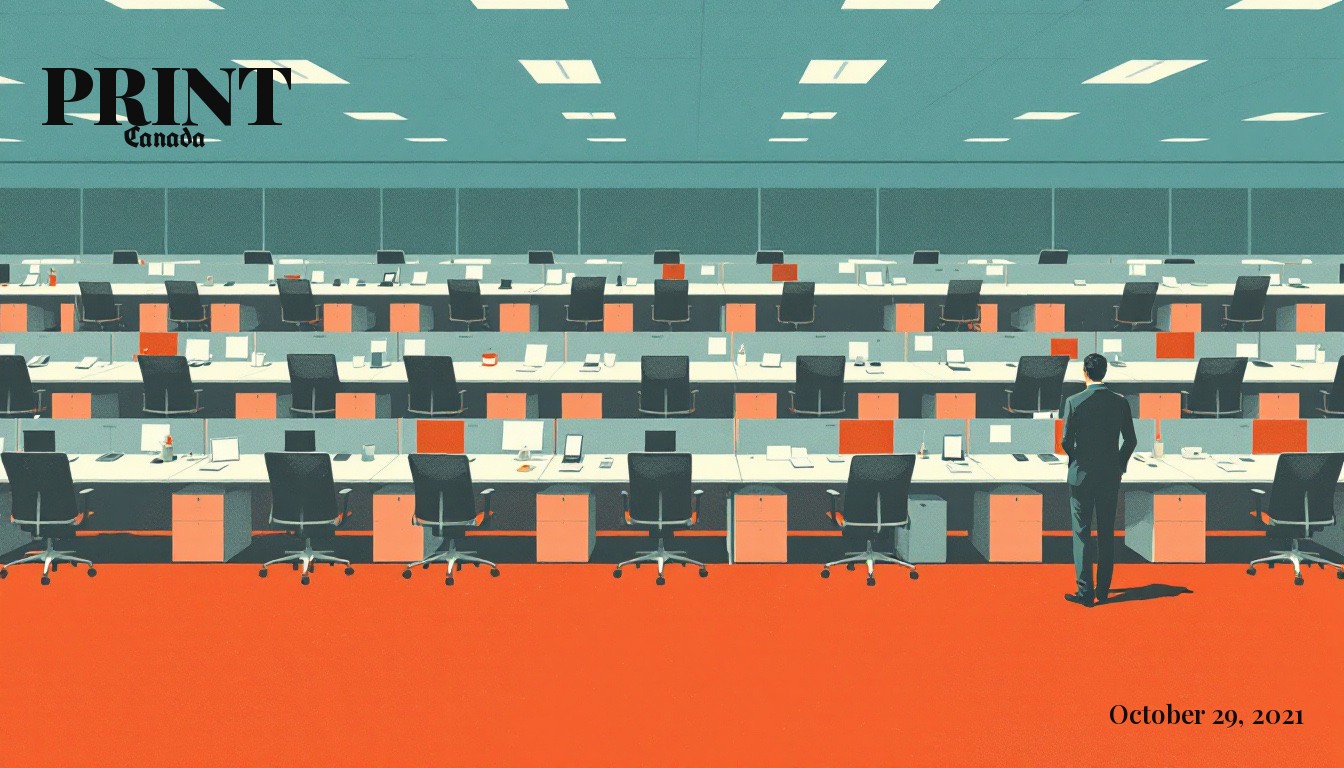
The empty chairs the vaccine mandate left behind.
In late 2021 the federal government required its 267,000 workers to be vaccinated, and those who refused were put on leave without pay. The number affected was small, around two thousand, under two per cent. The mandate was lifted in mid 2022. And the courts, for the most part, never ruled on whether it was lawful, because by the time the cases were ready, the policy was gone. This is a fair look back at a hard question the country chose not to answer.
Ottawa.This is a difficult one to write fairly, which is exactly why it is worth writing. In the autumn of 2021, with the pandemic still killing people and hospitals under strain, the federal government required that its public servants be fully vaccinated. The policy took effect at the end of October and reached across roughly two hundred and sixty-seven thousand workers, the RCMP included. Those who would not get vaccinated, or would not disclose their status, were placed on administrative leave without pay. Private employers and provinces followed with their own versions. For a while, a vaccination record became a condition of working, flying, and in some places entering a restaurant.
Two things about that period are both true, and the temptation of the last few years has been to grab one and drop the other. We are going to try to hold both.
The case for the mandate was real
Start with the part that the loudest critics tend to skip. This happened during a genuine emergency, in which a contagious disease was filling intensive-care units and killing the elderly and the vulnerable in large numbers. Vaccination measurably reduced severe illness and the load on a health system that was, in several provinces, days away from rationing care. Employers have a real duty to keep a workplace safe, and a government has a real interest in keeping the public service and the transport system running through a crisis. When the cases reached the courts and labour arbitrators, that is largely how they were decided: again and again, adjudicators found that the policies were reasonable responses to a real public-health threat, and that requiring vaccination did not, in law, force anyone to do anything, because a person remained free to decline and accept the consequence. The mandates, by and large, held.
And the cost was real, and fell on real people
Now the part the mandate's defenders tend to skip. The consequence of declining was not abstract. By the spring of 2022, more than two thousand federal employees were on leave without pay, cut off from their income for a personal medical choice. That is under two per cent of the workforce, a small share, and also more than two thousand households. Some lost homes. Some lost careers they did not get back when the policy ended. Whatever you believe about their decision, a country that takes away a person's livelihood is doing a serious thing, and seriousness demands that the action be tested against the Constitution, not just assumed to be fine because most people agreed with it.
The mandate was lifted in June 2022. Many of the legal challenges were then dismissed as moot, because the policy was gone. The country took away thousands of livelihoods and then, in large part, declined to rule on whether it had been allowed to.
The answer the country avoided
Here is the unsatisfying heart of it. The federal mandate was suspended in June 2022. And once it was gone, much of the litigation that might have settled the constitutional question collapsed, not on the merits, but on mootness, the principle that courts do not rule on dead controversies. The most prominent challenge to the travel mandate was dismissed as moot in late 2022, after nearly all the evidence had been heard, and the Supreme Court later declined to take it up. So the country did a grave thing, suspending people's incomes over a medical requirement, and then, when the policy ended, mostly arranged not to have a court decide whether the grave thing had been lawful. The people who lost their jobs never got a ruling. They got a shrug and a closed file.
The verdict
A fair retrospective does not pretend the mandates were tyranny, and they were not; they were a defensible response to a deadly emergency, and they were upheld where they were actually judged. But it also does not pretend the cost was nothing, or that the question was answered. The honest verdict is that the country made an extraordinary demand of its workers in a frightening time, that the demand was probably lawful and certainly upheld in most rooms where it was tested, and that for the minority who paid the steepest price, the system found a procedural way to never quite say so out loud. In an emergency, the state asks a lot. The least it owes, afterward, is a clear accounting of whether what it asked was within its rights. On this, the country mostly declined to give one.
A retrospective published in 2026. Drawn from the public record: the federal vaccination requirement effective in late October 2021, covering about 267,000 workers; roughly 2,108 federal employees (under two per cent) on unpaid administrative leave as of May 30, 2022; the suspension of the requirement on June 20, 2022; and the dismissal of several legal challenges, including the travel-mandate case, on mootness grounds, with the Supreme Court declining to hear a related appeal. Commentary weighing public health and civil liberties, not medical or legal advice.