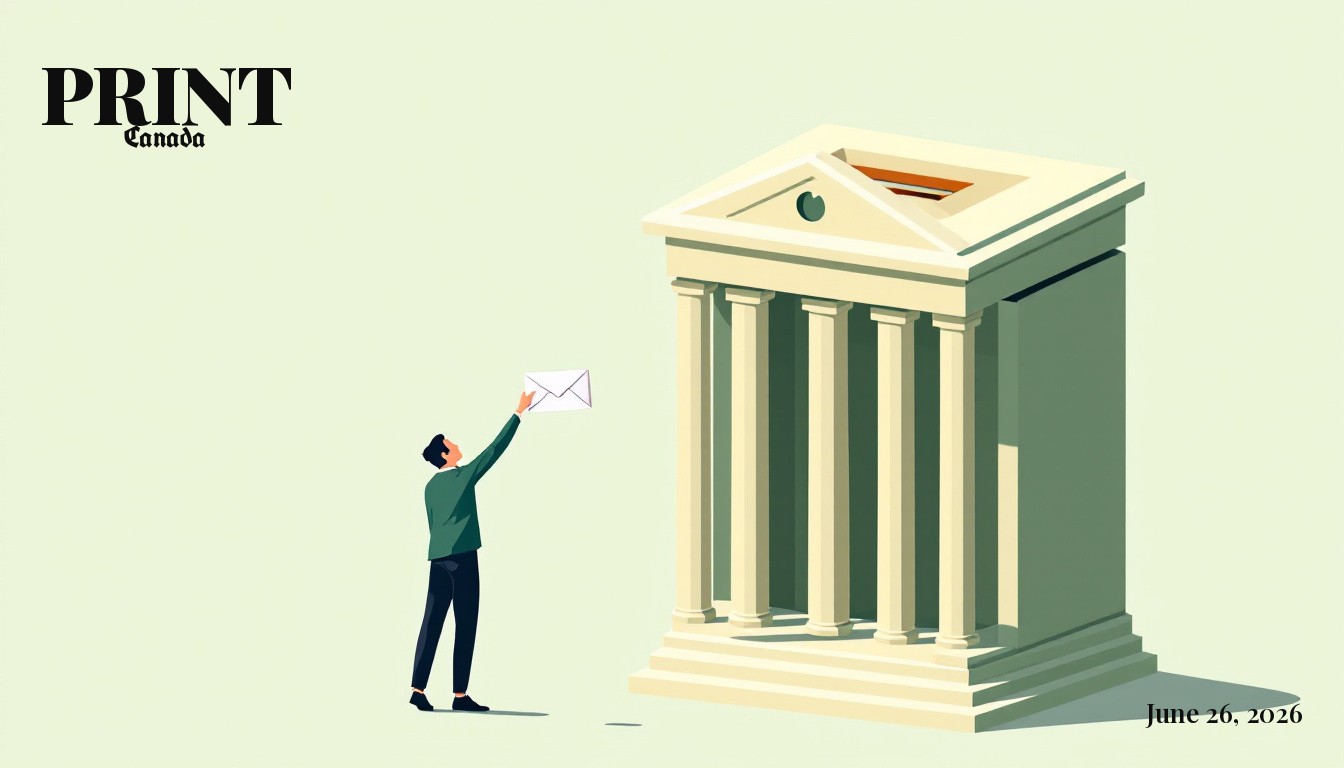
The government already knows what you owe. Stop making us file.
Your employer sends the government your income. Your bank sends it your interest. The agency already holds the slips it makes you copy back to it under threat of penalty. The technology to simply tell people what they owe, or are owed, exists and is already running for two million Canadians. The default is backwards. Make it automatic. Let the civilian dispute the number, or not. Simple.
Ottawa.Here is a thing that is true and that almost no one stops to find strange. Every spring, millions of Canadians sit down in a state of low dread to report to the government a set of numbers the government already has. Your employer already sent the Canada Revenue Agency your T4. Your bank already sent it your T5. Your investment slips, your pension, your EI, most of what goes on the first page of a return, the agency received directly from the institutions that paid you, often before you did. Then it asks you to copy those numbers back to it, accurately, on time, under penalty if you get them wrong.
That is the part worth saying plainly. For a very large number of people, filing a tax return is not an act of disclosure. It is a transcription test, graded by the same office that wrote the answer key and already holds it.
The technology is not the obstacle. It is already running.
This is not a futurist's wish. The CRA already operates a service, now called SimpleFile, that does exactly what it should. For Canadians with lower incomes and simple situations, the agency uses the information it holds to file for them, by phone or online, for free. This past season more than two million people were eligible. Of those invited, about ninety-three per cent went through with it, and the agency has said roughly three billion dollars in benefits and credits flowed to people as a result, money many of them would have missed entirely because they had not filed at all.
Read that figure again, because it is the whole argument in one number. Three billion dollars that belonged to ordinary people was sitting unclaimed, not because they did not qualify, but because the country built a paperwork wall between them and their own money and called the wall a duty. When you knock a piece of the wall down, the money simply arrives.
The agency already holds your slips. Filing is not telling the government something it does not know. For most people it is repeating, under threat of penalty, something it already wrote down.
What the country is doing about it, slowly
To be fair, Ottawa has noticed. The most recent federal budget promised pre-filled returns: the CRA would fill in what it knows, and a Canadian with a simple situation could open their account, look at the completed return, and approve it. Good. That is the right direction. But look at the timeline. The plan begins in 2027 for about one million people, and is meant to reach somewhere around five and a half million by 2029. In a country of more than thirty million tax filers, a pre-filled return that arrives at the end of the decade for a sixth of the population is not a transformation. It is a pilot with a long runway.
The honest objection, and why it is not a reason to wait
There is a real complication, and it deserves to be stated rather than waved away. Canada's tax code is genuinely, almost comically complex. The country's own taxpayers' ombudsperson has warned that the system is so tangled that automating it fully is hard, a complexity one account bluntly described as completely nuts. Deductions, credits, side income, caregiving, disability amounts, a self-employed year, a move, a separation: the machine does not know about the things only you know about. That is true.
But notice what that objection actually argues for, and what it does not. It argues for keeping the right to disagree. It does not argue for keeping the duty to begin from a blank page. The two are not the same, and the country has quietly let the second masquerade as the first.
The fix is a change of default, not a leap of faith
Here is the simple version, the one a person should be able to demand. The default flips. The government computes what it can from the information it already holds, and it tells you: based on what we have, you owe this, or we owe you this. That number arrives the way a bill or a statement arrives. If it is right, and for millions of people with one job and one bank it will be right, you do nothing, or you tap approve, and you are done. If it is wrong, if you have deductions the agency cannot see or income it does not know about, you say so. You dispute it. You amend it. You add what is yours to add. The obligation to be honest does not go anywhere. What goes away is the obligation to be your own unpaid data-entry clerk for an office that already has the data.
Automatic by default. Dispute by choice. That is not a loophole and it is not a giveaway. It is the arrangement a competent system would have offered from the start, and the one several other countries already run without their economies falling over.
Who actually pays for the current setup
It is worth being clear about who loses under the system as it stands, because it is not the people you might assume. The confident and the comfortable buy software, or pay an accountant, and move on. The people the maze actually catches are the ones with the least margin: the person working two jobs who finds the forms baffling, the senior on a fixed income, the newcomer navigating it in a second language, the person whose year was too chaotic to face the envelope. Those are precisely the people most likely to be owed a refund or a benefit, and most likely to miss it. A return you must initiate is a tax on disorganization and fear, and it falls hardest on the people least able to pay it. We have written before about the paid maze the country calls help, the alphabet soup a citizen is left to navigate alone. Tax season is the largest room in that maze, and the country built it on purpose and keeps it standing out of habit.
The verdict
Stop terrorizing people every spring for information you already hold. The agency has the slips. The agency has the technology, it is already filing for two million people and putting billions back in their pockets. There is no good reason the same thing cannot be the normal way the country does this, with the right to argue fully preserved for anyone who needs it. Tell us the number. Let us dispute it if we disagree. Otherwise, leave us alone. It really is that simple, and the only thing standing between Canadians and the simple version is the country's strange attachment to making them afraid.
This is an opinion essay grounded in publicly reported facts about the Canada Revenue Agency's SimpleFile service, the automatic-filing figures it has published, and the pre-filled-return commitment in the most recent federal budget, current to 2026. Specific figures: more than two million eligible for SimpleFile, roughly ninety-three per cent of invitees filing, about three billion dollars in benefits and credits, and pre-filled returns planned from 2027 reaching roughly 5.5 million people by 2029. General commentary, not tax advice.