How to file a complaint against a police officer in Ontario.
If an officer treated you wrongly, there is a body whose job is to hear about it. Here is who handles police conduct complaints in Ontario, how to file, and what can realistically happen.
PRINT Canada reporting on policing: use of force, custody, body-worn cameras, and police accountability in Ontario.
If an officer treated you wrongly, there is a body whose job is to hear about it. Here is who handles police conduct complaints in Ontario, how to file, and what can realistically happen.
On a February night near Stone Road East in Guelph, a man called 911 about a vehicle. Eleven minutes later he called back and cancelled. The dispatch log records the reason in three words: came to agreement. The officers were already moving, and they did not turn around. One of the charges the accused now faces rests entirely on the call that was withdrawn before they ever arrived.
If an officer comes to your car window, the law draws clear lines around what you have to do, what you can decline, and where your rights begin. Here is the plain version, for the moment when you need it and have no time to read a statute. This is general information about Ontario and Canadian law, not legal advice for your situation.
The minutes after an arrest are when most people give away the most, and when their rights matter the most. There are three things to know and one sentence to say. This is general information about Canadian law, not legal advice.
A man sat in a parked car in front of his home in Kitchener on the afternoon of March 15, 2026, working on a laptop physically mounted to the steering wheel. The engine was off. There were no keys. The car was in Park. Tesla's own vehicle telemetry confirms it never moved. Three officers arrived. What happened over the next seventeen hours and twenty minutes is documented on nine cameras, confirmed in six independently produced vehicle data points, and contradicted in five official police documents submitted to a bail court, a charge-screening Crown, and a provincial court judge.
The arresting officer in a Guelph impaired-driving matter runs an Axon body camera and a transport in-car recording system. Both are made by the same manufacturer. On the night of the arrest, the transport recording ran for two hours and eleven minutes. Every single audio sample across those two hours, all 754,680,736 of them, registered at exactly negative ninety-one decibels. That is the codec noise floor. That is silence. Her body camera, on the same night, at a bit rate sixty-three times higher, captured normal sound.
At three minutes past four on the afternoon of March 15, 2026, a citizen in custody at a Kitchener police station, who had been denied his prescribed insulin and clonazepam three times, performed a handstand against the wall of Interview Room 9. At approximately fourteen minutes past four he was on his hands and knees on the floor. At approximately thirty-nine minutes past four he was in a fetal position. At approximately two minutes past six, he was placed in front of the Intoxilyzer. The booking report filed by the arresting officer says: Force used, No. Conductive weapon used, No. The station cameras say otherwise on both counts.
Ontario police services have, over the last six years, deployed body-worn cameras at a cost to the public that this province's auditor general estimated, in a 2024 report, at over two hundred million dollars. The cameras are supposed to produce an objective record of police-citizen encounters. What the country has not built, alongside the camera deployment, is any independent mechanism for verifying that the record the camera produces is the record that actually happened. The gap between these two things is where this story lives.
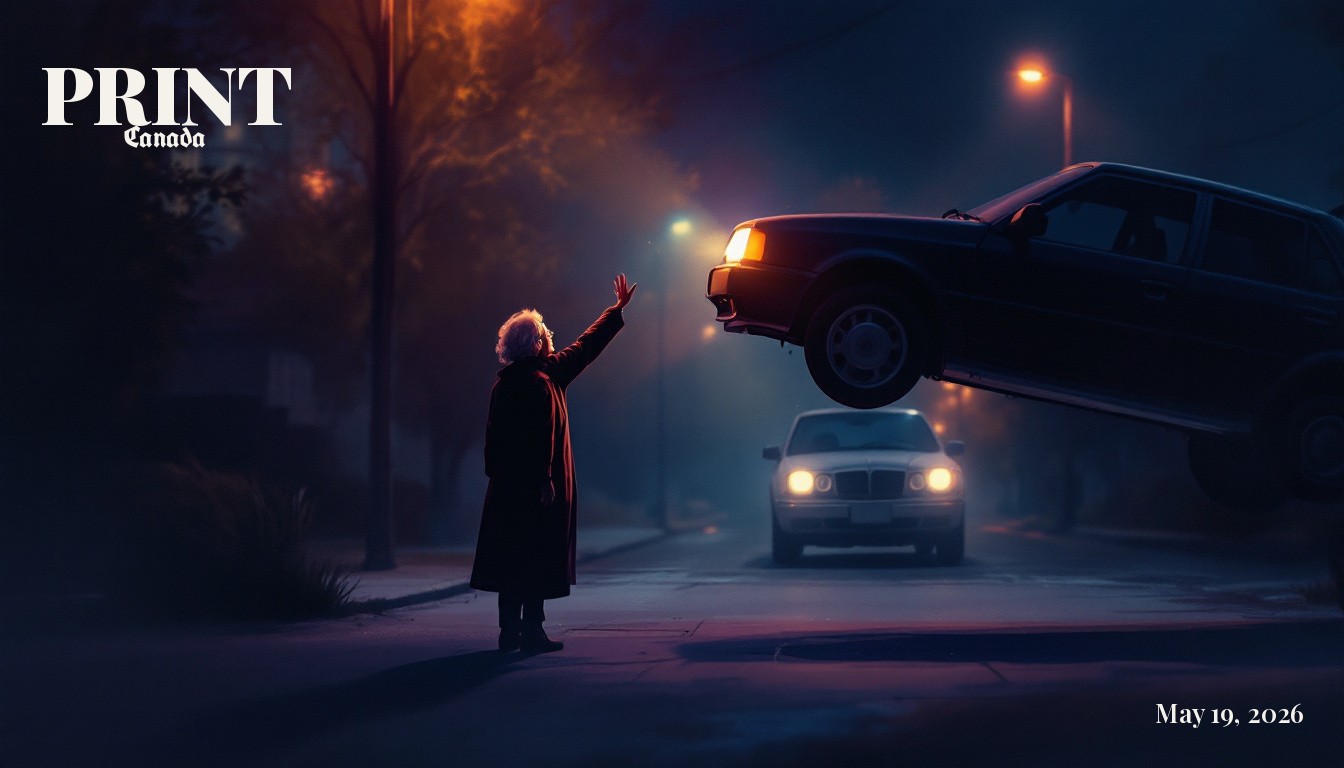
The arrest was the citizen's. The cell was the citizen's. The bail order was the citizen's. The car the regional police service of record sent the tow truck to remove from the curb belonged to neither the citizen nor the citizen's lawyer nor the citizen's defence file. It belonged to a senior in her seventies who had not been charged with anything, had not been suspected of anything, had not been spoken to by the police on the night in question, and who had no operational reason on this earth to have been deprived, by morning, of the vehicle she uses to drive a ninety-six-year-old to her medical appointments. The country, when it allowed the regional police service of record to send the tow truck, allowed the senior to be the secondary victim of a policing decision she was not part of.
He gave up the bedroom for six visiting family members, four of them children. He took a blanket, walked outside, and got into a car at the curb. The car was off. The keys were not on the scene. The car belonged to the seventy-two-year-old woman who lives at the house and cares for the ninety-six-year-old who owns it. He fell asleep. Four armed officers arrived. No screening device was used. No field test was administered. No alcohol inquiry was made. The lawyer he asked for has now twice confirmed, in writing, on her own letterhead, that no call from the police reached her firm that day. The car was towed by a contractor who needed skates because there was no key. He spent the night in a cell. Three charges were filed against a man who, by every available reading of the verb, had been sleeping. Every second of it was recorded on three independent video sources. This is the country's policing in plain English. Read it slowly. Read it twice.
An officer who refuses to give their name and number, when a citizen lawfully asks for them, has failed at the floor of their job. The country has accepted this failure for too long. There is no operational, statutory, or moral defence of it. There is, however, a long and embarrassing record of officers behaving, on the public dime, like the high-school children they once were and were never asked to outgrow.
One officer's death, one accused who had been out on bail, and within a year Parliament had rewritten who has to prove they deserve their freedom before trial. A retrospective on Bill C-48, the politics of catch and release, and the Charter principle that quietly shifted underneath it.
On the fourteenth of February, 2022, the federal government reached for a power the country had never used and froze bank accounts, compelled tow trucks, and drew lines on the map citizens could not cross. A public inquiry later said the bar was met, but reluctantly. A Federal Court judge later said it was not met at all. Years on, the precedent matters more than the protest, and the law is still unsettled.
Canada's privacy commissioners found Clearview AI had scraped three billion faces illegally. Then came the harder lesson: what a finding can and cannot make a company do.