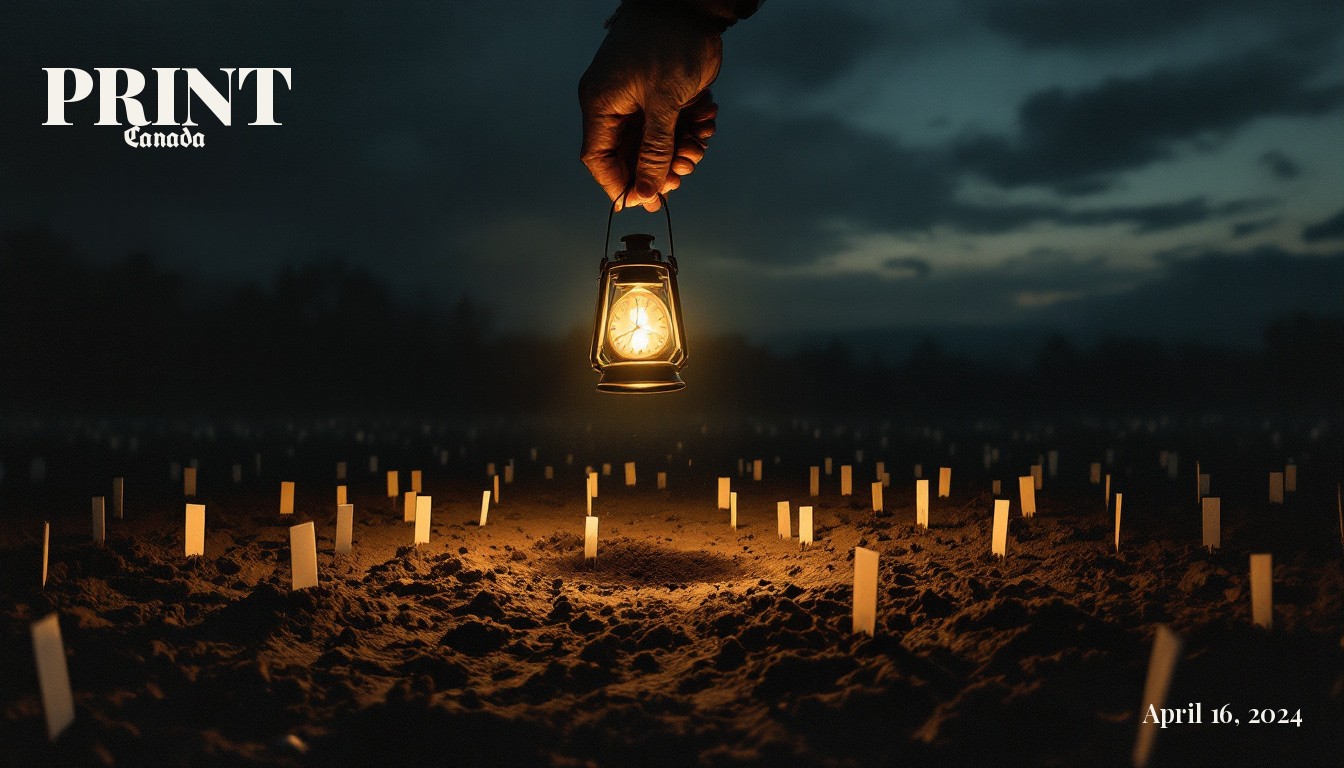
The searches the country promised, then began to walk back.
After Kamloops, Canada told First Nations to search the grounds of the schools themselves, and put real money behind it. Then, with the work nowhere near done, it started looking for the exit. A retrospective on a search that runs on the communities' timeline, and a country that keeps trying to set a deadline on grief.
OttawaOn the sixteenth of April, 2024, the federal budget set aside ninety-one million dollars over two years for First Nations to keep doing the work the country had asked of them after Kamloops: to walk the grounds of the former residential schools with ground-penetrating radar, to document what the soil holds, and to commemorate the children who never came home. It was real money, and it followed real grief. It was also, written into the same budget line, a two-year clock on a task that no one who understood it believed could be finished in two years.
That is the quiet contradiction at the centre of this story. In the summer of 2021, after the Tk'emlups te Secwepemc First Nation announced probable unmarked graves at the former Kamloops school, the country's answer was to tell communities to search, and to fund them to do it. More than a hundred sites came into view. Nations across the country began the slow, deliberate work of surveying land their families had been buried in without record. And then, before that work was anywhere near complete, the same government that had urged it on began, in increments, to step back from it.
Why the work is slow, and why that is not a flaw
It helps to understand what the searching actually is. Ground-penetrating radar does not find bodies. It finds anomalies, disturbances in the soil whose depth and placement are consistent with a burial. Confirming what lies beneath requires excavation, and excavation is a decision that belongs to the affected Nation alone, made on its own terms and often, understandably, declined. Some communities will dig. Many will not, choosing to mark and protect the ground rather than disturb it. Either choice is theirs. None of it moves at the speed of a fiscal year. The slowness is not inefficiency. It is the careful pace that a graveyard demands, applied by the people with the most right to set it.
The country found the money in a hurry in 2021. It began looking for the exit before the families had finished looking for their children.
The walk-back, in stages
The retreat did not arrive as a single announcement. It came as a series of smaller ones, each easy to miss. In the summer of 2024, communities learned that Ottawa was weighing whether to cap or reallocate the search money as the program's end date neared. The pushback was immediate, and in mid-August 2024 the Justice Minister reversed the proposed changes and said the work would continue. That was the reassuring version. The quieter version came in early 2025, when the government ended funding for the National Advisory Committee on Residential Schools, Missing Children and Unmarked Burials, the body assembled to guide and coordinate the searches. Its members were told the money would stop at the end of March. Then the 2025 federal budget arrived with no new funding for the investigations at all, a silence the Canadian Archaeological Association called out in plain terms.
An international body, the International Commission on Missing Persons, had already said the obvious thing: that Canada should establish sustainable funding beyond 2025, for as long as communities need it. That is how the rest of the world treats a search for the missing. You fund it until it is finished, not until the appropriation runs out.
What is established, and what is contested
Precision matters here, because this subject has been pulled into a bitter argument. What is established: the searches are community-led, communities can apply for grants of up to three million dollars per initiative, and the federal money was committed and then, in pieces, curtailed. What remains careful and unconfirmed by design: the anomalies at Kamloops and many other sites have not been excavated, and so the specific counts at any one site await work the Nations may do or decline on their own schedule. Those two facts sit together without contradiction. The absence of an excavation is not evidence the history was invented. It is evidence that the people who own the grief are taking more care than the country that caused it ever did. This is the same record laid out in our piece on what Canada's own Truth and Reconciliation Commission documented years before Kamloops.
The verdict
A country can be measured by what it funds after the cameras leave. In 2021 Canada committed, with genuine feeling, to help First Nations find their dead. By 2025 it had quietly let the coordinating committee lapse and tabled a budget with nothing new for the search. The work was never going to fit a two-year window, and everyone serious knew it. The same impulse that left clean water and housing unsettled, the subject of our piece on the tap water the country still cannot make safe, runs through this too: a generous announcement, a slow withdrawal, and a hope that no one is still counting when the funding ends. The families are still counting. That is the timeline that should govern this, and it is the one the country keeps trying to overrule.
A retrospective published in 2026. This essay draws on the public record: the federal Budget 2024 commitment, announced April 16, 2024, of $91 million over two years for community-led efforts to locate, document, and memorialize burial sites at former residential schools; the summer 2024 reports that Ottawa was considering capping or reallocating that funding, and the mid-August 2024 reversal by the federal Justice Minister; the early-2025 decision to end funding for the National Advisory Committee on Residential Schools, Missing Children and Unmarked Burials, with members told funding would cease at the end of March 2025; the absence of new funding in Budget 2025, flagged publicly by the Canadian Archaeological Association; and the recommendation of the International Commission on Missing Persons that Canada sustain funding beyond 2025. Written with deliberate factual care out of respect for survivors and the families still waiting.