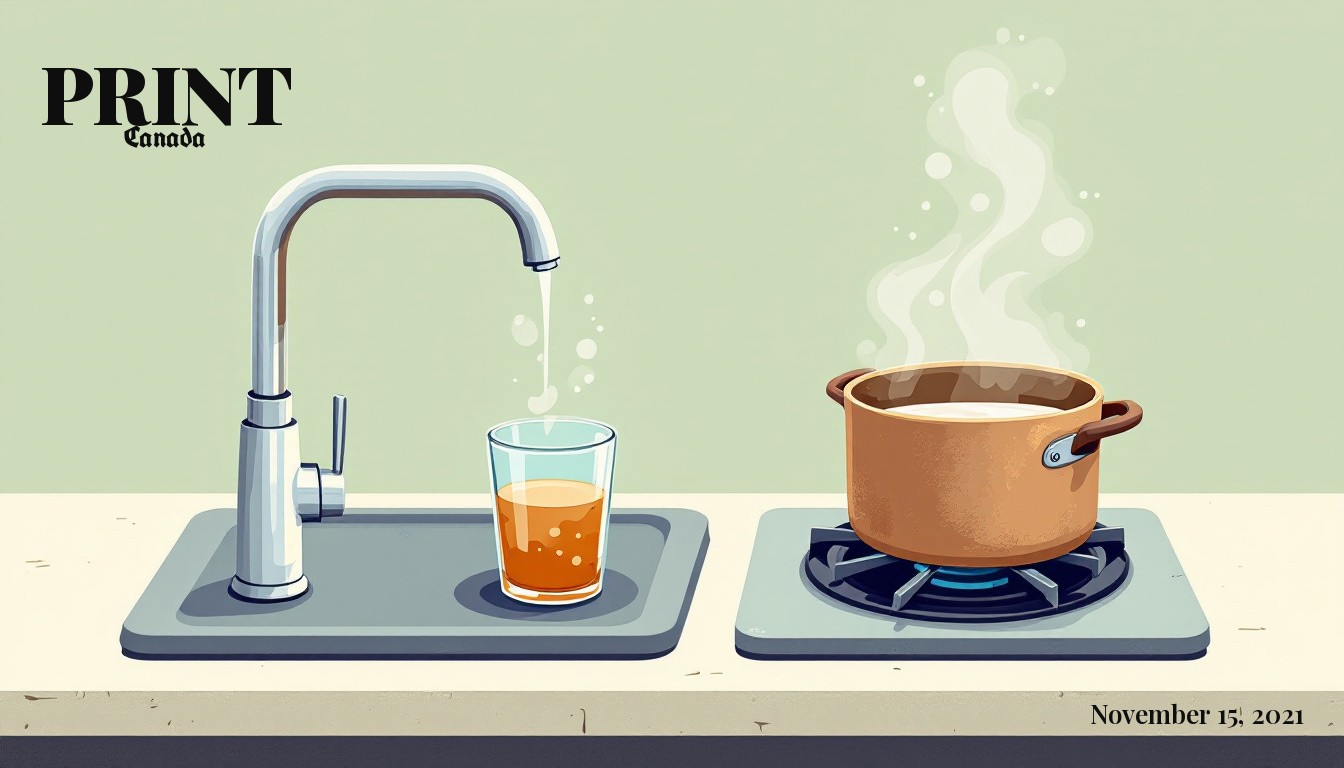
The tap water the country still cannot make safe.
In 2015 the federal government promised to end every long-term drinking water advisory on First Nations land within five years. The deadline passed in 2021. Years later, dozens of communities still cannot drink from their taps, and one northern community has been boiling its water since 1995. This is a retrospective about a promise the richest version of the country keeps explaining instead of keeping.
Ontario.There is a number the country prefers to discuss in terms of progress, and there is a way of looking at the same number that is harder to forgive. In 2015 the incoming federal government made a specific, dated promise: it would end every long-term drinking water advisory on First Nations land within five years, by March of 2021. It was a good promise, concrete and measurable, the kind a country can be held to. The deadline came. The deadline went. And the advisories did not end.
Here is where the progress framing is true, and where it stops being enough. Since late 2015, more than a hundred and fifty long-term advisories have in fact been lifted, which is real work and real water, and no honest account erases it. But as of 2026, roughly three dozen long-term advisories are still in force across about as many First Nations communities, and the trend has stopped looking like a march to zero. In some recent years, more advisories were added than were lifted. The line that was supposed to reach the floor has flattened, and in places bent back up.
Thirty years of boiling
If a statistic cannot make you feel it, one community can. Neskantaga First Nation, a remote community in northern Ontario, has been under a boil-water advisory since 1995. That is not a typo and it is not a backlog. It is the better part of thirty years in which a community in a G7 country has not been able to safely drink what comes out of the tap, in which a generation of children has grown up understanding clean water as something that arrives in jugs and trucks. The repairs meant to finally end it have themselves slipped, year after year, with completion pushed, most recently, into the back half of 2026. A person born in Neskantaga the year the advisory began is now thirty years old and has never had a safe glass of tap water at home.
A child born in Neskantaga the year its boil-water advisory began is now thirty, and has never once been able to safely drink from the tap at home. The promise to fix this was made for a deadline that passed five years ago.
Why it does not get finished
The reasons are real and they are also, mostly, excuses dressed as reasons. The communities are remote, which makes construction expensive and short building seasons shorter. The systems, once built, need trained operators and stable funding to run, and that funding has been uncertain enough that some advisories return after a plant is fixed, because the plant cannot be properly staffed or maintained. A long-promised law to guarantee clean water as a right, Bill C-61, the First Nations Clean Water Act, died before it passed, and the government has said it will try again. Each of these is a true difficulty. None of them explains why the same country can build whatever it decides is a priority, on time, when the people waiting are not on a reserve.
What this is really a measure of
Clean water is the plainest test a country can be set, because there is no ideology in a tap. You either can drink the water or you cannot. That is why the broken deadline matters beyond the water itself: it is the most concrete, least deniable version of the gap this country keeps revealing between what it says about reconciliation and what it is willing to fund. We have written about the reckoning of 2021, the flags at half-mast, the holiday, the speeches. A holiday is easy. A water treatment plant that works, in a place that is hard to reach, paid for and staffed for as long as the people live there, is the harder thing, and it is the thing that was actually promised.
The verdict
Progress is real and it is not the standard the country set for itself. The standard was zero, by 2021, and it was the government that chose both the target and the date. Five years past that deadline, dozens of communities are still boiling their water and one has been doing it for thirty years. A nation that can find the money and the will for anything it genuinely decides matters has told First Nations communities, by the simple evidence of the unfinished plants, where they sit on the list. Reconciliation that cannot deliver safe tap water is not yet reconciliation. It is a statement of intent, repeated annually, while the jugs keep arriving by truck.
A retrospective published in 2026. Drawn from the public record: the federal commitment made in 2015 to end all long-term drinking water advisories on First Nations land by March 2021; more than 150 long-term advisories lifted since November 2015; roughly three dozen still in effect across a similar number of communities as of 2026, with advisories added as well as lifted in recent years; the boil-water advisory in Neskantaga First Nation in place since 1995, with remediation scheduled into late 2026; and the lapse of Bill C-61, the First Nations Clean Water Act, with a successor promised. Commentary, not legal advice.