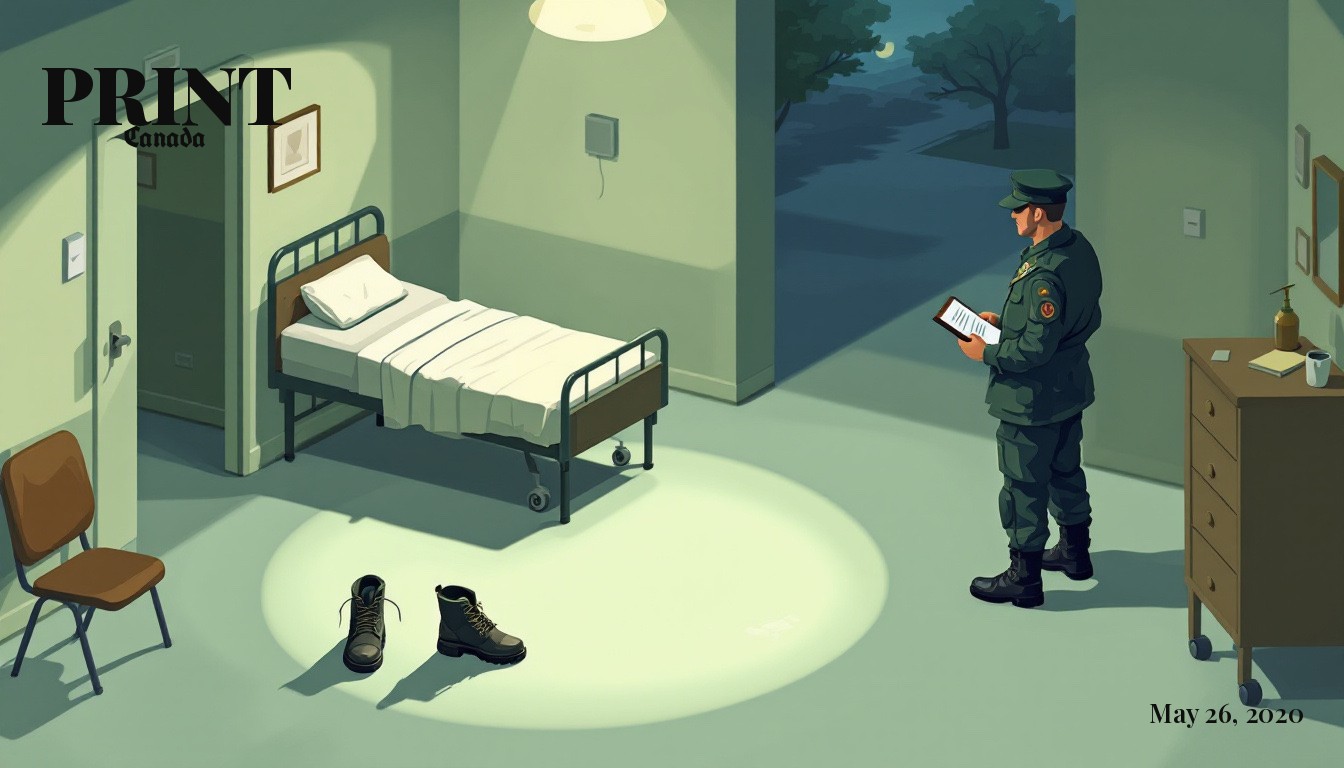
When the army walked into the care homes.
In the spring of 2020, Canada sent soldiers into long-term care homes that the virus had overwhelmed. What they wrote down, cockroaches, force-feeding, residents left calling for help, was so severe the province took control of five homes. A retrospective on the report that made the country look, and the question of whether anything changed.
TorontoIn the last week of May, 2020, Canadians read a document that should not have needed to exist. It was written not by a health inspector or an ombudsman but by the Canadian Armed Forces, whose members had been sent into long-term care homes that the first wave of the pandemic had simply overwhelmed. Roughly two hundred and fifty military personnel, nurses and medics among them, had been deployed, first to homes in Quebec in April, then to Ontario in early May. The report set down what they saw in their first two weeks. It is, even read years later, hard to get through.
What the soldiers found
The Ontario report covered five homes among the hardest hit: Orchard Villa in Pickering, where seventy-seven residents had died; Altamont in Scarborough, fifty-two; Hawthorne in North York, forty-three; Eatonville in Etobicoke, forty-two; and Holland Christian Homes' Grace Manor in Brampton, eleven. The conditions the personnel described were not failures of a single bad shift. They were structural. Rooms with cockroaches. Contamination with feces. Residents force-fed to the point of choking. Staff afraid to use protective equipment and supplies because, they were given to understand, the supplies cost money. People left in soiled beds, sedated, calling for help that did not come for hours. These are clinical details, and the clinical detail is the moral argument. You do not need to editorialize over a man left crying in a soiled bed. You only have to write it down accurately, which is what the soldiers did.
It took the army to make the country look. The inspections that were supposed to catch this had been running for years, and the conditions were waiting for the soldiers anyway.
What happened next
The response was swift, at first. The province moved to take temporary control of the five homes. The premier said operators could face charges and that what the report described was, in his words on the public record, the kind of thing that demanded accountability. Quebec, where the military had been deployed earlier and where homes like the one in the west of Montreal had seen their own catastrophes, produced its own grim picture. For a few weeks in the early summer of 2020, it seemed the country had been shown something it could not unsee, and that the long-term care sector, and especially its for-profit and chronically understaffed corners, would be remade.
Precision about what the report was, and was not
Fairness requires a few careful lines. The death tolls cited are the figures attached to those homes in that period. The report was based on what personnel observed in their first two weeks, not a full forensic audit, and the military said as much. It documented specific, severe failures at specific named homes; it did not indict every home or every worker in a sector where many staff worked themselves to exhaustion and beyond. And documentation is not the same as consequence. The criminal and regulatory aftermath, the inquiries, the lawsuits, the question of whether anyone was ever truly held to account, is a separate and far slower story than the report itself. What the report did was establish, beyond argument, the conditions. What it could not do was guarantee they would change.
The verdict
The military report of 2020 remains one of the most damning documents the pandemic produced in Canada, precisely because it was so plainly written. It told the country that its oldest and most vulnerable citizens had died not only of a virus but of neglect that predated the virus and outlasted the headlines. The honest question, six years on, is the one the report cannot answer for us: whether the sector was rebuilt, or whether the soldiers left and the conditions settled back into place once no one with a clipboard from the army was watching. A country that needs to send soldiers to read its care homes the way it once sent them overseas has already told you something about how it treats the people inside them. The reckoning of that spring was real. Whether it was finished is the part still owed. The same gap between a system that is technically there and one that actually reaches a person runs through our piece on eight hours in the emergency room and no diagnosis, and the civil-liberties cost of the pandemic's hardest choices is weighed in the empty chairs the vaccine mandate left.
A retrospective published in 2026. This essay draws on the public record: the Canadian Armed Forces deployment of roughly 250 personnel to long-term care homes in Quebec (April 2020) and Ontario (early May 2020); the military's report, made public in late May 2020, documenting conditions in five Ontario homes, with death tolls reported at the time of approximately 77 (Orchard Villa, Pickering), 52 (Altamont, Scarborough), 43 (Hawthorne, North York), 42 (Eatonville, Etobicoke), and 11 (Grace Manor, Brampton); the report's own note that it reflected observations from personnel's first two weeks; and the Ontario government's decision to assume temporary management of the five homes, with the premier stating publicly that operators could face charges. Written with deliberate factual care.